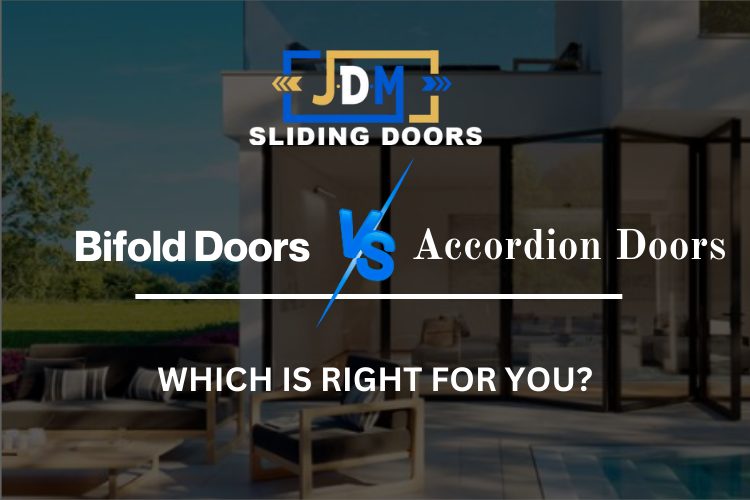
Bi-fold and accordion doors look similar at a glance. Both fold open, both run on tracks, and both promise to open up a space. The differences only show up after a year of daily use. We’ve installed and repaired both across South Florida for 18+ years, and the verdict is this: bi-fold doors are the right pick for interior openings and patios, accordion doors are the right pick for true room dividers and wider openings (12+ feet). The short version below shows you why; the long version covers what most comparison articles miss.
Bi-fold vs accordion doors at a glance
| Factor | Bi-fold doors | Accordion doors |
|---|---|---|
| How they open | Panels hinged in pairs, fold flat against the jamb | Panels concertina-fold (zig-zag) into a stack |
| Best for | Closets, patios, exterior openings up to 12’ | Room dividers, openings 8–25’ wide |
| Number of panels | Typically 2–6 panels | 4–20+ panels |
| Track style | Top + bottom track | Top track only (most common) |
| Material options | Wood, vinyl, fiberglass, aluminum | Vinyl, fabric-laminate, aluminum |
| Average install cost (6’) | $800–$2,500 | $400–$1,500 |
| Lifespan in South Florida | 15–20 years (quality units) | 8–12 years |
| Common failure points | Hinges, rollers, track misalignment | Hinge tabs, fabric tearing, latch wear |
| Hurricane-impact option | Yes (premium lines, e.g. NanaWall, LaCantina) | No (interior use only) |
| Sound dampening | Moderate to strong with sealed glass | Poor: panels don’t seal tightly |
| Re-track-ability | Easy with pro track repair | Difficult once hinge tabs break |
Bottom line up front: If you’re choosing between the two for a patio or exterior opening, bi-fold is the right answer (it can be impact-rated and it seals against weather). If you’re dividing two interior rooms or closing off a closet on a budget, accordion is faster, cheaper, and easier to install, at the cost of shorter lifespan.
What are bi-fold doors?
Bi-fold doors are made of multiple solid panels (typically 2, 4, or 6) hinged together in pairs. When you open them, each pair folds flat, like a wallet, and the entire door stack collapses against one or both sides of the opening. The panels ride on a track at the top, and most premium bi-folds also use a bottom track for stability.
The defining feature: each panel is a structural unit. The panels are usually made of wood, vinyl, fiberglass, or aluminum-clad wood, and they can carry insulated glass, impact glass, or solid material. That’s why bi-fold doors can be exterior-rated and even hurricane-impact-rated.
Where bi-fold doors shine
- Patio openings up to 12 feet where you want a “wall of glass” effect when open
- Pantry and closet doors where you want full access without door swing
- Interior room dividers that need to look architectural (formal dining → kitchen, primary bedroom → en-suite)
- Outdoor kitchens and lanais in South Florida, where premium fiberglass bi-folds can be impact-rated
Where bi-fold doors struggle
- Openings wider than 12 feet: beyond that, panel weight starts to stress the hinges and you’ll need an accordion or sliding glass wall system
- Older homes with out-of-square jambs: bi-fold tracks are unforgiving of uneven framing, so expect to budget extra for jamb modification
- High-humidity wood frames: without proper sealing every 1-2 years, the panels swell and stick (we replace a lot of swollen wood bi-folds in Hollywood and Hallandale Beach)
What are accordion doors?
Accordion doors are sometimes called “folding doors” or “concertina doors.” They’re constructed as a continuous string of narrow panels (typically 4-8 inches wide each) connected by hinges or hinge-tabs and ride on a single top track. They fold like a fan when collapsed: every other panel pivots in one direction, with the in-between panels pivoting opposite, creating the signature zig-zag stack.
Accordion doors are almost always interior-only. The panels are too narrow to support insulated glass and too lightweight to hold up under weather exposure. They’re built for division, not protection.
Where accordion doors shine
- Wide interior openings (8 to 25+ feet): there’s no practical limit to how many panels you can run on a single track
- Budget room dividers in offices, daycare centers, restaurant private rooms
- Closet doors in older Florida homes where the jamb is too crooked for a bi-fold track
- Temporary or rental-property solutions where lifespan matters less than upfront cost
Where accordion doors struggle
- Any exterior use: the panels don’t seal weather-tight, they’re not impact-rated, and the hinge tabs degrade in UV exposure
- High-traffic households with kids or pets: the narrow panels and exposed hinge tabs are easy to grab, pull, and break
- Sound isolation: gaps between panels make them roughly as sound-blocking as a heavy curtain
- Long-term durability: even premium accordion doors rarely last past 10-12 years in daily use, while bi-folds easily double that
Real installed cost in South Florida (2026)
These are real installed prices from our service calls in Broward, Miami-Dade, and Palm Beach counties. Width assumes a 6-foot opening (closet or interior pass-through size). Add 30-50% for 8-foot openings and 60-80% for 12-foot openings.
| Door type & quality tier | 6’ opening installed | 8’ opening installed | Impact-rated upgrade |
|---|---|---|---|
| Vinyl accordion (entry-level) | $400–$700 | $600–$1,000 | Not available |
| Aluminum accordion (mid-tier) | $800–$1,200 | $1,100–$1,500 | Not available |
| Vinyl bi-fold (entry-level) | $800–$1,200 | $1,200–$1,800 | Not available |
| Fiberglass bi-fold (mid-tier) | $1,400–$2,000 | $1,900–$2,800 | +$400–$700 |
| Premium fiberglass bi-fold (NanaWall, LaCantina) | $4,500–$8,000+ | $6,500–$12,000+ | included or +$1,000 |
For broader sliding door cost benchmarks, see our how much does it cost to replace a sliding glass door guide.
Operator insight: In 18+ years across South Florida, the failure rate split is consistent: bi-fold doors fail at the rollers and hinges (repairable in 90% of cases), accordion doors fail at the hinge tabs and panel tearing (repairable in 30% of cases). If you want to repair-not-replace down the road, choose bi-fold.
Bi-fold vs accordion doors: head-to-head
Durability and lifespan
Bi-fold doors: 15-20 years on quality fiberglass or aluminum-clad units. The most common failure is roller and hinge wear, which is repairable via our sliding door repair service without replacing the entire door.
Accordion doors: 8-12 years on mid-tier vinyl. The failure mode is usually hinge-tab fatigue (the plastic tabs that connect panels snap), which often forces full replacement because individual tab replacement is rarely cost-effective.
Track and roller hardware
Bi-fold doors: Use a top track and (usually) a bottom track. The bottom track is the weak point: debris, pet hair, and tile grout dust accumulate and bind the rollers. Routine track cleaning and lubrication every 6 months extends lifespan by years.
Accordion doors: Use a single top track. The advantage is no floor obstacle and no debris collection. The disadvantage is all the door’s weight hangs from the top track, so any track sag or anchor loosening becomes immediately noticeable.
Weather and exterior use
Bi-fold doors: Can be exterior-rated and even hurricane-impact-rated in premium fiberglass lines. The panels seal against gaskets in the frame when closed, which makes them weather-tight.
Accordion doors: Interior-only. The panels don’t seal against each other tightly enough to keep out wind, rain, or insects. Don’t install accordion doors on any exterior opening.
Sound dampening
Bi-fold doors: With insulated glass, they dampen sound moderately well, comparable to a standard interior door. Solid-panel bi-folds (wood or fiberglass) dampen sound better.
Accordion doors: Poor sound dampening. Gaps between panels and the lightweight construction mean sound passes through easily. Don’t pick accordion if you’re trying to make a home office quiet.
Aesthetic and design fit
Bi-fold doors: Lean architectural. The visible hinges, glass panels (when applicable), and clean fold create a deliberate design feature. They make a small space look intentional and modern.
Accordion doors: Lean utilitarian. Most accordion doors look obviously like room dividers; they don’t disappear into the design. There are premium versions that look better, but at the price point of a premium accordion, you can usually buy a mid-tier bi-fold.
Florida-specific considerations
If you’re installing either door type in South Florida, three factors matter more than national reviews suggest:
- UV exposure. Direct sun degrades vinyl and accordion fabric panels 2-3x faster in South Florida. For any opening facing south or west with direct sun, pick fiberglass bi-fold over vinyl bi-fold and don’t pick accordion at all.
- Humidity and wood swelling. Wood bi-fold panels swell in summer humidity and stick. If you want a wood look without the maintenance, pick fiberglass bi-fold with wood-grain finish.
- Hurricane code (HVHZ). If you’re in Miami-Dade or Broward and the opening is exterior, you legally need an impact-rated door. Only premium fiberglass bi-fold lines carry HVHZ-approved NOA stamps. Accordion is not an option for exterior openings in these zones.
Which door is right for you?
Pick bi-fold if you’re:
- Opening a patio or exterior space to the outdoors
- Adding a “wall of glass” feature for a lanai or pool deck
- Looking for a 15-20 year solution
- In Miami-Dade or Broward and need impact-rated doors
- Willing to spend $1,500-$8,000+ on a quality unit
Pick accordion if you’re:
- Dividing two interior rooms (kitchen ↔ dining, office ↔ den)
- Closing off a closet or pantry on a budget
- Working with a wide opening (10+ feet) where bi-fold becomes impractical
- Looking for a sub-$1,500 solution
- Renting or selling within 5 years
Pick neither (consider sliding glass doors instead) if you’re:
- Looking for the best long-term durability AND aesthetics
- Want a maintenance-light solution
- Building or renovating where the opening can accommodate a slide-aside system
Frequently asked questions
Which lasts longer in South Florida, bi-fold or accordion doors?
Bi-fold doors typically last 15-20 years in South Florida coastal homes (premium fiberglass or aluminum-clad units), while accordion doors typically last 8-12 years. The difference comes down to construction: bi-fold panels are individually structural, while accordion doors rely on hinge tabs that fatigue under UV and daily use.
Can I use an accordion door for a patio or exterior opening in Florida?
No. Accordion doors are interior-only. They don’t seal weather-tight against wind, rain, or insects, and they’re not available with impact-rated glass. For an exterior patio opening in Miami-Dade or Broward, you’ll need a bi-fold or sliding door rated for HVHZ (High Velocity Hurricane Zone) with a Miami-Dade NOA stamp.
How much does it cost to install a bi-fold door vs an accordion door in Fort Lauderdale?
For a 6-foot opening in 2026: a basic vinyl accordion installs for $400-$700, a mid-tier aluminum accordion runs $800-$1,200, a vinyl bi-fold runs $800-$1,200, and a mid-tier fiberglass bi-fold runs $1,400-$2,000. Impact-rated premium fiberglass bi-folds (NanaWall, LaCantina) start around $4,500 for a 6-foot opening.
Are bi-fold and accordion doors energy efficient?
Bi-fold doors with insulated glass perform similarly to standard sliding doors: moderately energy-efficient. Accordion doors are not energy-efficient, because gaps between panels allow air infiltration and they’re not designed for thermal performance. For South Florida summers, only bi-fold doors with Low-E insulated glass are worth considering on a temperature-controlled boundary.
Can bi-fold and accordion doors be repaired?
Bi-fold doors are highly repairable: rollers, hinges, and tracks can be replaced individually, and most issues are fixable for $150-$400. Accordion doors are harder to repair because the most common failure (hinge-tab fatigue) typically requires panel replacement, and panels often aren’t sold individually. For both, our sliding door repair team can diagnose whether a repair is cost-effective vs full replacement.
What’s the difference between a bi-fold door and a folding patio door?
“Folding patio door” usually refers to a premium exterior-rated bi-fold door designed for wide openings; brands like NanaWall, LaCantina, and Marvin make these. They’re a subset of bi-fold doors, engineered with stronger hinges, weather seals, and larger panel sizes (often 3+ feet per panel). Accordion doors are not the same thing: those are interior, narrow-panel concertina-style doors.
The honest professional verdict
For exterior openings or anything you’ll use daily for the next 15+ years, install a bi-fold door. For interior dividers on a budget where you accept replacing the door every decade, an accordion door is fine. Don’t try to use accordion doors as a stand-in for bi-fold on an exterior: every accordion-on-patio install we’ve seen has needed full replacement within 3 years.
If you’re not sure which one fits your specific opening, our sliding door installation team provides free in-home assessments across Broward, Miami-Dade, and Palm Beach counties. Call (954) 689-2155 or book online for a free 30-minute consultation. For broader door style comparisons, our 10 types of sliding doors guide walks through all the major door categories and where each fits best.