Pocket Door Roller Replacement
The door gets harder to pull every month, and it has started to make a flat clunking sound as it travels. A pocket door hangs from two roller carriers that run in a track above the opening, and those carriers do all the work.
Nylon wheels go flat. Bearings dry out and seize, and a seized wheel skids along the track instead of turning. Once that starts, the wheel wears the track too, which turns a parts job into a track job if it is left.
Pocket door rollers are not standardized. The carrier has to match the track profile, and the hanger bolt has to match the bracket already fitted to the top of your door. We identify the set from the track shape and the bracket rather than from the door, because the same door takes different gear depending on who built the pocket.
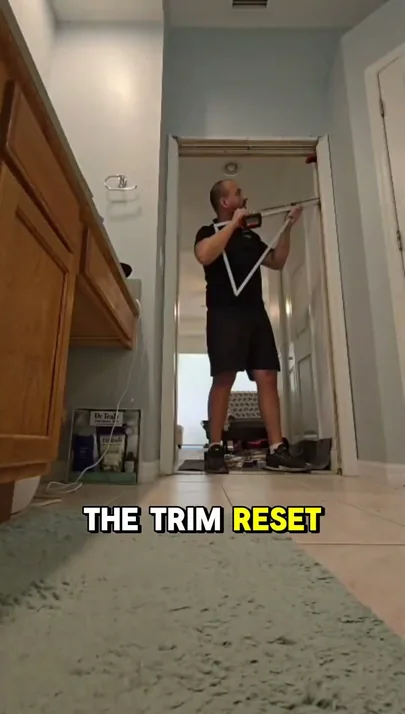
The panel comes far enough out of the pocket to reach the hangers. New carriers go in, and the height bolts are reset so the door hangs level and the latch meets its strike. The split jamb trim comes off and goes back the same way, so a roller replacement needs no drywall work.
What you will notice
- A door getting steadily harder to pull
- A flat clunk or a scrape as it travels
- A door that has dropped at one end
- A wheel that will not spin by hand
Pocket Door Track Repair and Replacement
The door runs fine for most of its travel and then binds at the same place. Inside the wall, the track above the opening has bent, lost a screw into soft header wood, or worn a flat spot where a seized wheel skidded on it.
A pocket door track is a thin steel or aluminum channel screwed to the header. It is strong enough for a door hung correctly, and not strong enough to survive a wheel dragging on it or a door being pulled down at its bottom edge. Both of those bend the lip the wheels run on.
We take the panel out and sight along the track. A short bend in sound metal straightens and holds. A track twisted along its length, or one whose screws have torn free, gets replaced and anchored into framing that will take the load, which sometimes means adding backing inside the pocket.
Replacement does not have to mean opening the wall. In most pockets the track comes out through the opening once the panel and the split jamb trim are off. Where the pocket was framed shut behind drywall, we will tell you that before the work starts rather than after.
What you will notice
- Binding at the same point on every pass
- A door that has dropped since a derailment
- A rattle overhead as the door travels
- A track visibly bowed when you look along it
Pocket Door Off-Track and Jumped Roller Repair
A pocket door off the track leans into the room, drops at one end, or stops short of the pocket. Once it has happened it tends to happen again, because whatever let the wheel out is still there.
There are three reasons a wheel leaves the track. The track has bent open at the mouth, the end stop is missing or has worked loose, or someone pulled the door hard at the bottom and levered the top out. So we take the panel out and look at the track before touching any hardware.
A short bend in sound metal straightens and stays straight. A track twisted along its length, or one whose screws have torn out of soft header wood, gets replaced and anchored back into framing that will hold it. Then the running gear: wheels sized to the hanger, new brackets where the old ones are bent, and the stop reset at the back of the pocket.
The last check is a slow pass end to end, listening for the click of a wheel riding over a damaged spot.
What you will notice
- The door dropping at one end and leaning into the room
- A wheel clicking over the same point every pass
- The door stopping short of the pocket
- More than one derailment since the last repair
Pocket Door Adjustment
The door catches the floor at one corner, the latch misses the strike by a hair, or daylight shows down the closing edge. All three mean the same thing: the door is no longer hanging level.
A pocket door hangs from two roller brackets bolted into the top of the panel, and each bracket carries a threaded bolt that sets the height. Pocket door adjustment happens at those bolts. When one side drifts down, the leading edge stops meeting the jamb square, and everything else follows from that.
We pull the panel far enough out of the pocket to reach the hangers, turn them until the door sits level and lands flat on the jamb, then reset the floor guide so the bottom cannot swing. The wall stays shut through all of it: the split jamb trim comes off and goes back the same way.
One thing to watch for. If the door rubs partway into the pocket rather than at the opening, no amount of adjusting will help. That is usually a drywall screw driven too far through the pocket frame, and we find it with the panel out.
What you will notice
- Daylight down one side of the closing edge
- The door catching the floor at one corner
- A latch sitting above or below the strike
- Rubbing that starts partway into the pocket
Pocket Door Hardware Repair
The latch no longer catches, the pull has worked loose in the door edge, or the privacy lock turns without holding. The door itself is fine. The parts you put your hand on are worn out.
Pocket door hardware is its own small set, and it does not swap with ordinary door hardware. The pulls sit flush in the edge and the face of the panel so the door can disappear into the wall. The latch is an edge pull and a mortise lock cut into the leading edge. The floor guide at the bottom of the opening is what stops the panel swinging, and it is the part most often missing altogether.
We work to the cutouts already in your door. A flush pull is replaced with one that covers the existing mortise rather than one that needs a bigger hole, and where an earlier repair has over-cut the edge we fit a plate that spans it. Privacy latches are matched to the backset the door was cut for.
Two things get checked at the same time, because hardware rarely fails on its own. The door has to hang level, and the floor guide has to be there and set to the panel thickness. A latch on a leaning door misses its strike no matter how new it is.
What you will notice
- A latch that no longer catches the strike
- A flush pull loose or pulled out of the edge
- A privacy lock that turns without engaging
- A bottom edge that swings free of any guide
Pocket Door Installation
A new pocket door is two different jobs depending on what is in the wall now. Where a pocket frame already exists, it is a door, a hanger set, and a day. Where there is none, the wall has to be opened and a pocket frame built into it, and that means framing and drywall work before any door goes in.
The wall decides whether it is possible at all. A pocket needs clear space beside the opening as wide as the door, with nothing in it: no structural post, no plumbing stack, no electrical run that cannot be moved. We check all three before quoting, because a pocket found to be impossible halfway through the job is the worst version of this work.
Pocket frame kits are not equal, and the difference shows up in year three. Steel-reinforced split studs stay straight, and a header rated for the door weight keeps the track from sagging. A light kit under a solid-core door is what produces a door that rubs inside the wall, which is the most common complaint we get called about on somebody else's install.
We hang the door, set the height at the hangers, fit the floor guide and the jamb stops, and adjust the latch with the door in the opening. Then we run it all the way in and out a dozen times, because a pocket door that works at the opening can still catch at the back of the pocket.
What you will notice
- A swing door using floor space you need
- A doorway in a tight hallway or a small bathroom
- An existing pocket with a door past repair
- Rubbing from inside the wall on a recent install



 ★★★★★