Commercial Door Closer Repair and Adjustment
The front door slams hard enough to rattle the glass, or it drifts to within an inch of shut and stops there. Both come from the same box. The door closer is the arm and cylinder mounted at the top of the door, and its job is to pull the door shut on its own after every use.
Inside, a closer is hydraulic fluid behind a piston, metered by two or three small valves. Sweep speed governs most of the swing, latch speed governs the last few inches, and backcheck stops the door being thrown open into the wall. Those are adjustments. A door that slams or stalls is often a quarter turn of a valve rather than a new unit.
What no adjustment fixes is a leak. Once fluid is weeping down the body or onto the frame, there is no pressure left for the valves to meter and the closer gets replaced. We also replace a unit whose arm has bent or whose screws have torn out of the door, because a closer anchored into damaged metal pulls itself loose again.
On a door that has to meet accessibility rules, opening force is not a preference. We set the closer so the door opens within the force allowed, still latches on its own, and closes slowly enough for somebody coming through with a cart or a walker. Spring size, arm type, and where the closer is mounted all feed into that, so we look at the door before ordering a replacement for it.
What you will notice
- A door that slams or bangs the frame
- A door stopping short of the latch
- Oil weeping from the closer or down the frame
- A door that takes real effort to push open
Commercial Door Hinge and Continuous Hinge Repair
The door has started dragging on the frame at the latch corner, or there is a dark wear mark where the top of the door rubs. Stand inside and watch the hinge edge while somebody opens it. If the knuckles separate or the screws move, the hinges are carrying a door they can no longer hold.
Butt hinges, the three or four separate hinges most doors hang on, fail at the pin and at their screws. The pin wears oval, the door sags, and the sag puts every pound of door onto the top hinge, whose screws then start pulling out of the frame. By the time the latch misses the strike, the top hinge is usually the one at fault.
A continuous hinge is the alternative. It is one aluminum hinge running the full height of the door, so the weight is spread along the whole edge instead of three points. On a busy entrance, or a door that has already torn out its hinge screws twice, that is the repair rather than another set of butt hinges in the same tired holes.
We check the frame before the hardware. Stripped screw holes are repaired into solid material and a racked frame is squared, and only then do new hinges go on. Some aluminum storefront doors turn on pivots at the top and bottom instead of hanging on hinges. There the worn part is the pivot, and the idea is the same: fix what is carrying the door, then reset the latch to the frame.
What you will notice
- A door dragging on the frame at the latch corner
- Hinge screws standing out or spinning in their holes
- Knuckles that separate when the door opens
- A latch sitting below the strike
Panic Bar and Exit Device Repair
An exit door that takes two pushes, or one that stays latched when you hit the bar, is a safety problem rather than a maintenance item. It gets looked at the day you notice it.
A panic bar, also called a crash bar or an exit device, is the horizontal bar across an exit door that releases the latch when anybody pushes on it. A rim device latches into a strike on the frame. A vertical rod device runs rods up and down to latch at the head and the sill. A mortise device sits inside the edge of the door. Which one you have decides both the repair and the part.
The common faults repeat from building to building. Dogging, the setting that holds the latch retracted during business hours, gets left engaged and the door stops latching at night. Vertical rods drift out of adjustment until the top latch no longer reaches its strike. Touchpad springs weaken and the bar stays pushed in. An alarm kit or an electric latch retraction kit fails and takes the release with it.
We test the device from inside with one push, then check the outside trim, the strike, and how the door sits in its frame. A worn rod or latch is replaced on its own. A cracked device body, or one that has been painted over, gets a new unit matched to the door's fire rating, because the hardware on a rated door is listed together with the door.
What you will notice
- A bar that needs more than one push to release
- A door that does not latch at closing time
- A touchpad that stays pushed in
- An alarm that sounds on every use, or never
Commercial Door Alignment and Drag Repair
Staff have started shoving the door with a hip, or lifting it at the handle to get it to shut. The door has moved in its frame, and every piece of hardware on it is now working against that.
Commercial doors go out of alignment because something is carrying them badly. Hinges or pivots wear. A closer pulls the door in on a different line than it used to. The frame racks under daily traffic. A worn threshold drops the height the door rests at. The door looks the same as it always did; the gaps around it do not.
We measure the gap at the head, the hinge edge, and the latch edge with the door shut. An even gap means the door is square, and an uneven one shows where it has dropped. Then we fix the cause in order: hinges or pivots first, frame second, hardware last. Moving a strike to meet a sagging door hides the fault for a few months and makes the next repair bigger.
On a pair of doors, the place to look is the astragal, the strip where the two doors meet. Daylight through the middle of it means both doors are leaning away from each other, so both sides need resetting rather than one.
What you will notice
- A door that needs a hip or a lift to close
- Uneven gaps around a shut door
- A latch that misses the strike by a few millimeters
- Daylight between a pair of doors at the middle
Commercial Locks, Latches, and Strike Alignment
Staff have started pulling the door toward them to get the key to turn. That is the tell. The bolt is hitting the lip of the strike instead of going into it, and it is worth dealing with before it becomes a security problem.
Doors move. Hinges wear, pivots settle, an aluminum storefront door racks slightly out of square under daily traffic, and a closer starts pulling the leaf in on a different line than it used to. The lock itself is usually fine. Where it sits relative to the frame is not.
The one to take seriously is a deadlatch on a storefront door. Once the door is out of line, the small plunger beside the bolt gets damaged, and a damaged plunger is what lets a locked door be pushed open. The door looks shut, and it is not.
So we check the door in its frame first and the hardware second: reset hinges or pivots, square the leaf, move or replace the strike, and change the latch where the bolt or plunger is worn. Where an electric strike or a card reader sits in the opening, we test it under power as well as by hand, because a latch that works on a key can still fail on the fob.
What you will notice
- Staff pulling the door to get the key to turn
- A door that looks shut but opens with a push
- A bolt that scrapes the strike lip every cycle
- A fob or key that works only sometimes
Commercial Door Threshold Replacement
You can see daylight under the front door, or rain tracks inside every time there is a storm. Look at the aluminum saddle across the bottom of the opening. If its edge is worn round and flat, the door sweep has nothing left to seal against.
That saddle is the threshold, and it takes every cart, hand truck, and shoe that crosses your entrance. Commercial door threshold replacement comes up sooner on a busy door than most owners expect. On a pair of doors it fails twice over, because the two halves stop meeting and the seal between the leaves closes on nothing.
We measure the opening and the frame profile before ordering, since a saddle that is close is not a saddle that fits. The old unit comes out, the substrate underneath is cleaned and sealed, and the new threshold is set in sealant and anchored into solid material. Then we reset the sweep height and close the door on it to check the seal across the full width, not only at the latch.
What you will notice
- Daylight or a draft under a closed door
- Water tracking inside the entrance in heavy rain
- A saddle that shifts or rattles underfoot
- Anchor screws standing proud of the surface
Commercial Door Weatherstripping
There is a line of daylight around the closed door, a whistle on a windy day, and an entrance that never feels shut no matter how hard the closer pulls. Air you are paying to cool is going out through that gap all day.
Commercial door weatherstripping is not one product, which is why a trip to the hardware store rarely settles it. There is gasket in the frame stop, a sweep along the bottom of the leaf, an astragal between a pair of doors, and on storefront doors a pile strip set into a slot that wipes against the mating stile.
Each one fails its own way. Gasket takes a set and stops springing back. Sweeps wear down against the threshold. Pile packs flat and loses the brush that does the sealing. From inside the building they all feel the same, which is why the part gets misdiagnosed so often.
We match the profile to your door before ordering, because slot widths and gasket shapes are not interchangeable between manufacturers. It goes in with the door closed on it, so the seal is set to the gap the door has now rather than the gap it had when it was new.
What you will notice
- Daylight visible around a closed door
- Whistling or a steady draft at the entrance
- Weatherstrip that stays flat when you press it
- A door that never seals even after a closer adjustment
Emergency Commercial Door Repair
A commercial door becomes an emergency in one of two directions. It is stuck open, so you cannot secure the building and nothing else matters until you can. Or it is stuck shut on a door people need, which on an exit door is a life safety problem rather than a Monday problem.
The first thing we do on an emergency commercial door repair call is separate securing the opening from fixing the door. Those are two different jobs, and they do not always finish on the same visit.
A storefront with a failed deadlatch can be secured today by swapping the lock or fitting a temporary cylinder, even when the replacement latch is a week out. An automatic slider that has lost its operator can be locked down in manual mode so the entrance still works as a swing door. Getting the building safe first is what buys time to do the repair properly.
What we can finish in one visit comes down to parts. Closers, hinges, pivots, latches, strikes, and thresholds are common enough that we carry them. Operators, control boards, and anything proprietary to a system get identified on the visit and ordered, with the opening left secure in the meantime. We run same-day emergency service where we have capacity in your area, and we say so on the phone rather than after.
What you will notice
- A door that will not lock at closing time
- An exit device that will not release from inside
- An automatic door stuck open or cycling on its own
- Glass or a frame damaged in a break-in or an impact
Commercial Door Maintenance
Commercial doors rarely break all at once. They drift. A closer loses a little pressure every month until the door no longer latches on its own. Sensor timing creeps until the door closes on a cart. A hinge wears until the latch sits a few millimeters below the strike.
Each of those is a small adjustment while it is small, and a parts job once it has been left. That gap is the whole argument for commercial door maintenance: the same fix costs a fraction on a scheduled visit, and it happens while the building is quiet instead of during trading hours with a technician working across your entrance.
It suits some buildings more than others. A door that cycles a few hundred times a day, an entrance on a property that gets audited, or a site where an out of service door costs real money will all pay for a schedule. A back office door that opens twice a day will not. We will tell you which of your openings belong on one and which are better left on call.
What you will notice
- Doors that have started needing a pull or a push to latch
- More than one emergency call on the same opening this year
- An entrance that has to pass an inspection
- Several buildings with no record of when doors were last serviced
Office and Tenant Door Repair
Most of the doors in an office building are not entrances. They are suite doors off a shared corridor, conference and private office doors, server and storage rooms with their own locks. They see less weather than a storefront and far more handling, so they fail at the hardware instead of the frame.
The list is short and we see it every week. A closer that slams or no longer pulls the door shut. A lever that has dropped on its spindle. An office lockset where the button will not hold. A door that has swollen or dropped just enough to catch the frame.
On a suite door there is often a card reader or an electric strike in the mix, which turns a simple latch fault into a question of whether the hardware or the power is at fault. We test both before replacing either.
We work on occupied floors, which mostly means working around people. Suite doors get done before opening or after close where a tenant needs the office quiet, and we carry the common levers, closers, and strike plates so a floor of small faults is one visit rather than three.
What you will notice
- A suite door that slams or will not close on its own
- A lever that sags or turns without retracting the latch
- A privacy lock that will not stay engaged
- A reader that unlocks while the door stays latched
Commercial Door Installation
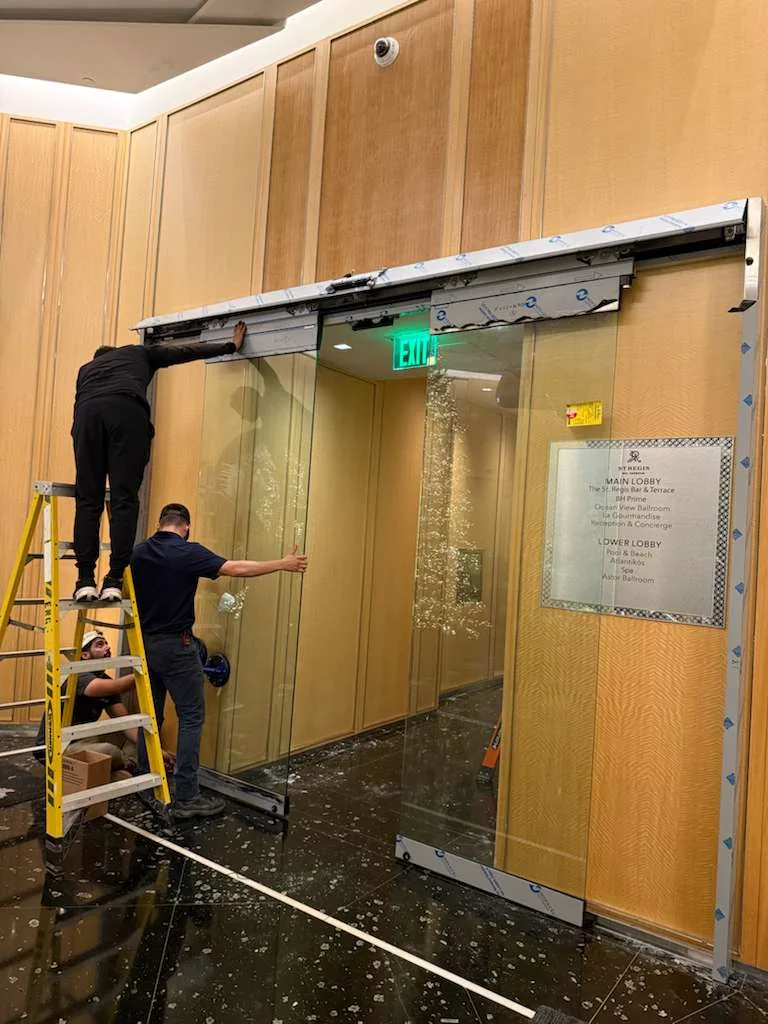
A commercial door gets replaced rather than repaired when the door or the frame has gone, not when the hardware has. A hollow metal door rusted through at the bottom, an aluminum storefront door twisted out of square, a frame pulled loose from the wall in an impact: those are new door jobs.
The opening decides nearly everything. We measure the frame rather than the old door, and note which way it swings and which side the hinges are on. On a storefront door we also record the stile width, because the lock has to fit inside it. We also check whether the opening is rated, since a fire door and its frame are listed as a set and the hardware on them has to be listed too.
Hardware carries over where it is sound and gets replaced where it is not. A closer with a bent arm or a worn exit device put back onto a new door wastes the new door, so we price the door and the hardware together and say which pieces are worth keeping.
Install day is built around your hours. The old door comes out, the frame is checked for square and anchored where it has worked loose, and the new door is hung and shimmed. Then the closer, exit device, and lock are set and tested with the door in its frame, before we leave the opening.
What you will notice
- A door rusted or split through at the bottom
- A door that no longer sits square in its frame
- A frame pulled loose from the wall
- Repairs on the same door more than twice a year














 ★★★★★
★★★★★