Your front entrance stopped closing on Friday afternoon, the store is standing open to the parking lot, and the only quote you can get is for a part nobody can price over the phone. Meanwhile the door two doors down at the pharmacy has run for years without anyone touching it. So which is it: are you unlucky, or is somebody doing something you are not? How often is this supposed to be serviced? What does a service visit even cover? And is the money you spend on it actually cheaper than the call you are making right now?
An automatic door maintenance visit covers the parts that wear on a schedule. That means the sensors, the drive belt and carriers, the motor and controller, the safety circuit, and the seals and threshold. Most commercial buildings need it twice a year. The trade body for the industry, AAADM, also asks owners to run a short safety check every day. It asks for a yearly inspection by a certified inspector on top of that. Our automatic door repair crews handle the service work itself in every market we cover. The same schedule logic applies to the rest of a building’s commercial doors.
By the end you will know what a maintenance visit includes, how often your doors need one, the three parts behind nearly every failure, what a door opening on its own is telling you, and when a problem has stopped being maintenance and become a repair.
Key takeaways
- Almost every automatic door failure is the motor, the controller, or the sensor.
- Twice a year is the working schedule for most commercial buildings.
- A door that opens on its own has a dead sensor, not a setting that needs adjusting.
- Daily safety checks are the owner’s job and take under a minute.
- Maintenance is cheaper than the emergency call it prevents, and it is schedulable.
What an automatic door maintenance visit actually includes
Most people picture someone spraying a track and leaving. A real visit works through the system in the order things fail.
- Sensors and activation. The activation sensor that sees you coming and the presence sensor that holds the door while you are in the opening. Both get tested, cleaned, and re-aimed.
- The safety circuit. The door has to reopen when something is in its path. This gets tested rather than assumed.
- Drive belt and carriers. Belts stretch and carrier wheels flatten. Both are cheap now and expensive once they strand a door.
- Motor and controller. Checked for fault codes, heat, and the noises that come before a failure.
- Running gear and track. Cleaned and lubricated so the panel moves freely instead of forcing the operator to work against it.
- Seals and threshold. The parts that let weather and grit into everything above.
- A written record. What was checked, what was adjusted, what was replaced, and what is close to needing attention.
How often automatic doors need servicing
Twice a year is the answer for most commercial buildings, and it comes from what happens to the ones that do it.
“We have customers that go twice a year to do a maintenance,” says Yuval, one of our elite technicians. Those are not the customers calling with an emergency.
That is the whole argument. The buildings on a schedule are not the ones phoning on a Friday afternoon.
Three things push a door toward more frequent service: heavy traffic, grit or sand blowing into the threshold, and a door that has already had a major part replaced. A quiet office side entrance can hold at twice a year comfortably. A grocery entrance in a windy parking lot is a different machine.
Alongside that, AAADM asks owners to run a daily safety check. It takes under a minute, and their published steps are simple:
- Walk at the door at a normal speed, from a few different angles. It should open smoothly every time.
- Step clear of the sensor. It should close on its own.
- Stand still in the opening. The door should stay open and wait.
- If the door has holding beams, cover each one with your hand and stand still. The door should hold.
Do it with care, and do not test a door you already know is closing hard.
The three parts behind almost every failure
There is no long list here, which is the useful part.
“It can be either the motor, the controller, or the sensor,” Yuval says. “Those are the most popular problems.”
That is why a good tech checks all three before quoting. What you notice at the door often points at the wrong one.
Say the door will not open. It could be a dead sensor that never sends the signal. It could be a controller that gets the signal and does nothing with it. Or it could be a motor that gets the order and cannot act on it. From the doorway, all three look the same.
The safety side of this is written down. ANSI/BHMA A156.10 is the standard for power operated pedestrian doors, and it exists to cut the chance of a user being hit or trapped. That is the bar a working door is held to, which is why a tech tests the safety circuit rather than taking your word that the door seems fine.
A door that opens on its own is called ghosting
If your door opens at random with nobody in front of it, that has a name.
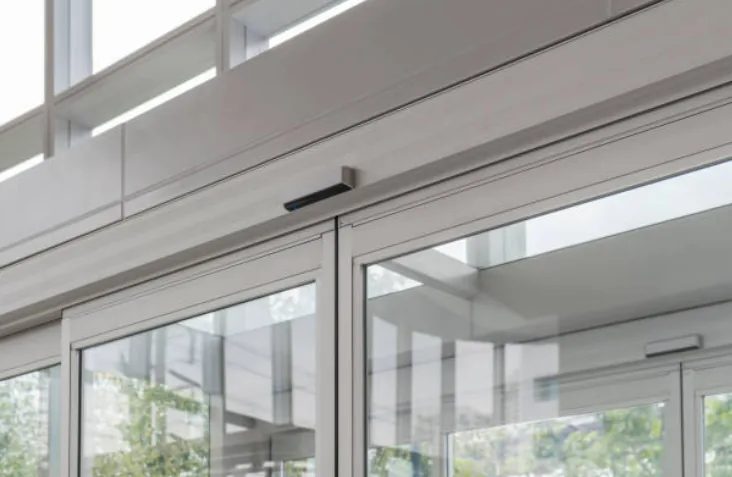
“It is called ghosting,” Yuval says. “When it starts to open randomly, the sensor is bad and you need to change to a new sensor.”
The instinct is to treat it as a setting. It is not, and the sensor gets replaced. We walk through that one and the four other symptoms owners call about in why your automatic door opens by itself.
When it has stopped being maintenance
Maintenance is what you do on a schedule. These are the ones that need a call now:
- The door will not close, so the building is open and unconditioned.
- The door closes too fast or too hard, which is a strike risk for older people and children.
- It stops partway, grinds, or drags.
- The presence sensor no longer holds the door for someone standing in the opening.
- Emergency breakout will not latch again after being pushed out.
- The door has started ghosting, which wears parts fast.
Breakout is worth treating as urgent even when the door still looks fine. That hardware is what people leave through when something goes wrong.
Storefront entrances often sit next to an automatic door and fail in their own way, usually a sagging panel or a closer that has given up. If that is the door giving you trouble, storefront door repair is the closer match.
One thing worth knowing about how this usually ends: parts get replaced, doors mostly do not. “If it is parts, it is replaced,” Yuval says. “If it is a door, we repair it, and most of the time you do not need to change it.”
Frequently asked questions
Can I do automatic door maintenance myself?
The daily safety walk, yes, and you should. Beyond that, no. These doors carry a powered operator and a safety circuit that has to be tested to a standard, and a door adjusted by feel can close hard enough to hurt somebody. Cleaning the sensor lenses is the honest limit of what to do without a technician.
Does maintenance cover the annual inspection?
No, those are two different things. AAADM asks for an annual inspection by a certified inspector, which is a separate credential. We are not that, and we will tell you so. What we do is the service and repair work, including anything an inspection turns up.
Will maintenance keep the door under warranty?
Usually it helps, because most manufacturers expect the operator to be serviced on a schedule and ask for records if a claim comes up. That written report from each visit is the thing you want on file.
Is it worth maintaining a door that is already old?
Often yes, because the expensive parts on an automatic door are the motor and the controller, and both outlast the belts and sensors around them by a wide margin. A door people write off as finished is frequently a carrier set and a belt away from running properly again.
What should I have ready when I call?
A photo of the header, the part above the door where the operator sits, and a description of what the door does rather than what you think is broken. The header photo usually identifies the brand and the system, which means the right parts are on the truck for the first visit.
Get your automatic doors on a schedule
JDM services automatic sliding and swing doors across Florida, New York, Georgia, Colorado, Texas, and Nevada, on every major brand. We can put your entrances on a twice-yearly schedule with a written report each visit, or come look at a door that has already stopped behaving. Call us and a real person will pick up, or request a free estimate and we will come to you.