You are pricing an automatic entrance for a store, a clinic, or an office lobby, and every quote names a different system. One says dormakaba, another says Stanley, a third says a brand you have never heard of. The numbers are a long way from each other and nobody has explained why. Which one will still have parts in eight years? Which is cheap now and costly later? Is the difference worth anything to you, or is it just the badge on the header?
Five systems cover most commercial automatic sliding doors in North America. They are dormakaba, ASSA ABLOY, Stanley, GEZE, and record. They are more alike than the price gaps suggest. What really separates them is parts. How fast can you get them, and can a tech tell what is in your header? Over ten years that beats any spec sheet. Our automatic door repair crews work on all five. The same header sits above many of the commercial doors we service.
By the end you will know the five systems you are choosing between, what actually drives the price, which parts fail first regardless of badge, how often these doors need servicing, and the one question to ask before you sign anything.
Key takeaways
- Five manufacturers cover most of the commercial market, and all five are serviceable.
- Parts availability matters more over a door’s life than the specification does.
- Every one of them fails at the motor, the controller, or the sensor.
- Twice a year is the working service schedule for a commercial entrance.
- Ask who services it before you ask what it costs.
What actually drives the price
Cost on these systems moves for reasons that have little to do with the brand:
- Retrofit or new opening. Fitting an operator into an opening you already have is one job. Building a new opening into a wall is another.
- Size and configuration. A single slide, a bi-parting pair, and a telescoping unit are three different mechanisms.
- Glass and framing. Impact-rated panels weigh more. More weight means a bigger operator.
- Sensors and activation. Basic motion activation costs less than a full presence-and-safety package.
- Breakout requirement. Emergency breakout hardware costs more. In many buildings it is not optional.
Ask for the quote broken out along those five lines. Two quotes that look nothing alike usually differ on just one of them. Once you can see which one, you can compare them properly.
Single slide, bi-parting, or telescoping
Before the brand matters, the shape does. There are three, and they cost different amounts to buy and to keep.
Single slide. One panel moves. One operator, one belt, one carrier set. It is the cheapest to buy and the cheapest to fix. It needs wall space beside the opening for the panel to sit in when open.
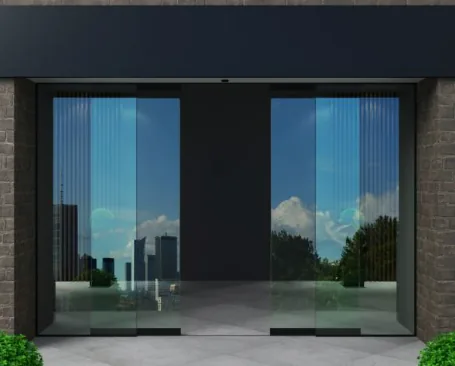
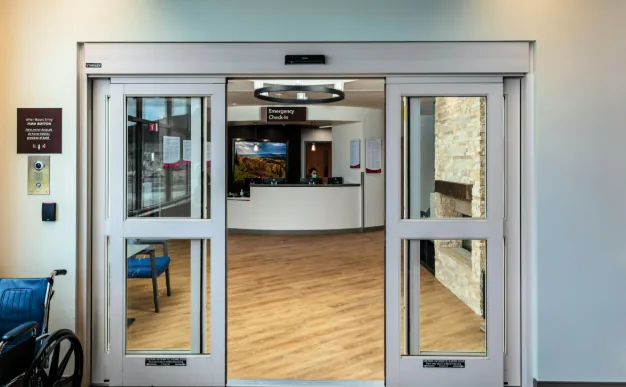
Bi-parting. Two panels part in the middle. This is the pair you walk through at most stores. It clears a wide opening without needing much side wall. There are two of everything, so parts cost more.
Telescoping. Two panels stack and slide together on each side. You use it when the opening is wide and the side wall is short. It is the most complex of the three, and it is the one where a worn carrier shows up soonest.
Most buyers land on bi-parting. Pick telescoping only when the wall space forces it. You pay for that choice again at every service visit.
One more thing worth asking about early. Check whether the opening needs emergency breakout, where the panels swing out under force. It changes the hardware and it is a code question, not a preference.
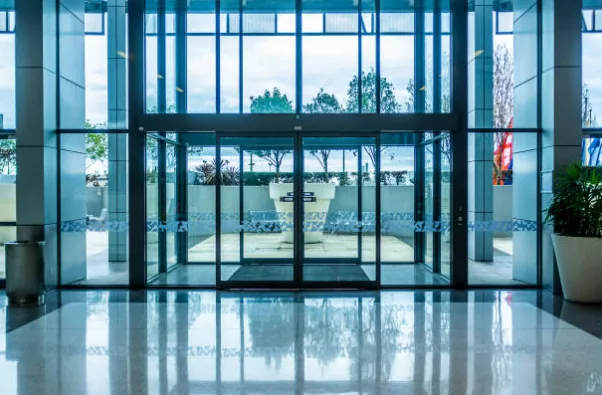
Commercial automatic sliding doors: the five systems
1. dormakaba
A German-Swiss maker with a wide commercial range. You see it in offices, hotels, and healthcare. It is common in North America, so parts and techs are easy to find.
2. ASSA ABLOY
The biggest group in the trade, and the parent of several door brands you know. Its sliding operators turn up in retail and public buildings. The service network behind it is the deepest of the five.
3. Stanley Access Technologies
The name most Americans have walked through without noticing. Stanley operators are all over US retail and grocery. That makes them the easiest of the five to get serviced fast, almost anywhere.
4. GEZE
A German maker known for slim operators. You see it where the header has to stay thin. It is a common pick on design-led storefronts and lobbies.
5. record
A Swiss maker, strong in healthcare and clean rooms. It is less common in general retail. Worth knowing when you think about who will service it later.
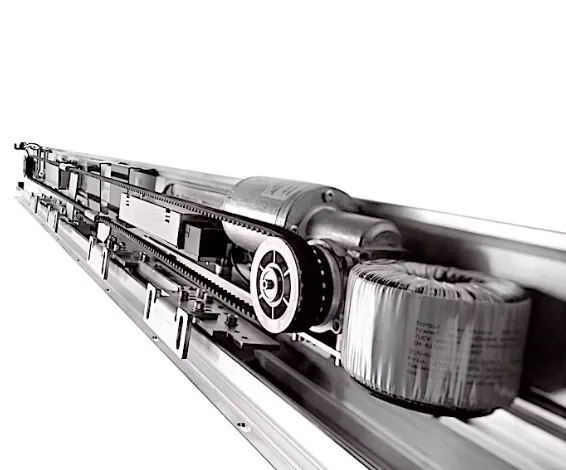
None of these is a bad system. Your ten-year cost is not decided by the badge on the header. It is decided by whether someone can get parts and knows the system well enough to fix it on the first visit.
The parts that fail, whichever one you buy
Spec sheets do not tell you this part. It is the same across all five.
“It can be either the motor, the controller, or the sensor,” says Yuval, one of our elite technicians. “Those are the most popular problems.”
For practical purposes that is the whole list. A dormakaba and a Stanley fail in the same three places, and the only real difference is how long you wait for the part.
One symptom is worth naming, because owners misread it all the time. If a door starts opening at random with nobody there, that is called ghosting.
“It is called ghosting,” Yuval says. “When it starts to open randomly, the sensor is bad and you need to change to a new sensor.”
It is not a setting, and no one can adjust it away. The sensor has failed and needs changing, and the same goes for the other symptoms owners call about. A ghosting door also opens all day for nobody. That wears the belt and carriers early, and it heats or cools the parking lot while it does it.
How often they need servicing
Twice a year for most commercial buildings. The reason is simple:
“We have customers that go twice a year to do a maintenance,” Yuval says. Those are not the ones calling with an emergency.
On top of that, AAADM, the trade body for the industry, asks owners to run a short safety check every day. It also asks for a yearly inspection by a certified inspector. The daily check takes under a minute. You walk the door, step clear so it closes, then stand still in the opening and confirm it waits for you.
These doors are built and tested to ANSI/BHMA A156.10. It covers power operated pedestrian doors. Its job is to cut the chance of someone being hit or trapped. It applies to all five systems the same way. That is one more reason the badge matters less than people think.
There is a version of that check worth doing on a schedule of your own, whatever the service contract says. Approach the door at a normal walking pace from both sides and watch where it starts to open, because a sensor that has drifted gives you less room than it did when it was set. Stand still in the opening and count how long it waits before it tries to close. Then push the leaf in the breakout direction to confirm it releases, since that is the part nobody tests until there is a reason to.
Write down what you find. Two people describing the same door four weeks later will not agree, and a technician can work from a note that says the north entrance started closing on a customer on a Tuesday afternoon.
Accessibility is a separate question
An automatic door is not automatically an accessible one. Opening force, hold-open time, threshold height, and the spot where the push button sits all have to be right. All of them drift as parts wear. If access is why you are buying, write it into the spec. Do not assume the operator takes care of it. Our ADA door repair page lists what actually gets measured.
Frequently asked questions
Do I have to use the original manufacturer to service the door?
No. Any good commercial door company works across all the major systems, and most do. Being tied to one maker’s service arm usually costs more. It rarely gets you fixed sooner.
How long should a commercial automatic sliding door last?
The operator and controller cost the most, and they outlast everything around them. Belts, carriers, and sensors wear out on a door this busy. An entrance people write off as finished is often a belt and a carrier set away from running well again.
What should I ask a supplier before signing?
Who services it, how fast they come out, and where the parts come from. A cheap system with a two-week parts wait costs you more than a pricier one that is running again the same week.
Can an old automatic door be upgraded rather than replaced?
Often, yes. Sensors and controllers can usually be updated without touching the panels or the frame. That costs a fraction of a new entrance. Ask about it before you accept a quote to replace.
Are these doors suitable for a small business, or only large retail?
They are used at every size. Traffic decides it, not floor area. A busy small clinic wears a door harder than a quiet large office.
Talk to someone who services all five
JDM repairs and replaces commercial automatic sliding doors across Florida, New York, Georgia, Colorado, Texas, and Nevada, on every major brand. Already have one that has started acting up? Send us a photo of the header. We can usually name the system before the truck leaves. Call us and a real person answers, or request a free estimate.