The door at your entrance slams hard enough to make people flinch, or it drifts shut and never quite latches. Either way it has been doing it for weeks and nobody wants to touch it.
Almost nothing about that is broken. A closer is adjusted with a hex key and two or three small screws, and the usual fix takes about two minutes once you know which screw to turn. Turn the wrong one and you get a door that will not latch at all, which is why most people leave it alone.
By the end you will know which screw does what, how to slow a door that slams, why a door closes but never latches, the four problems no adjustment will fix, and how fast the rules say your door should close.
I am Gal Cohen, field area manager at JDM Sliding Doors, and after hinges, the closer is the part our techs swap most on a storefront entrance.
Key takeaways
- Turn one valve at a time, a quarter turn at a time, and try the door after every turn.
- A door that closes but never latches is usually the latch speed screw, not a worn out closer.
- Oil on the closer body or running down the door means the seals are gone. No screw fixes that.
- Never back a valve all the way out. LCN warns that opening a valve too far makes the closer leak.
- The Americans with Disabilities Act (ADA) asks that a door take at least 5 seconds to move from 90 degrees open down to 12 degrees from the frame. Most slamming doors fail that.
What each screw on a door closer does
Short answer: almost every door closer complaint comes down to three small valves on the closer body, each controlling a different piece of the swing.
- Main speed, also called sweep: how fast the door travels through most of its arc. This is the screw for a door that slams.
- Latch speed: the last few inches, right before the door pulls into the frame. This is the screw for a door that drifts and never quite shuts.
- Backcheck: how hard the door is slowed when somebody throws it open, which keeps the handle out of the wall.
- Spring power: a separate adjustment, not a valve, that sets how hard the door pulls itself closed.
How I know: LCN’s installation sheet for the 4040XP, one of the most common closers in the country, lists those valves in that order. It puts a normal closing time at 5 to 7 seconds from 90 degrees open, split evenly between main speed and latch speed.

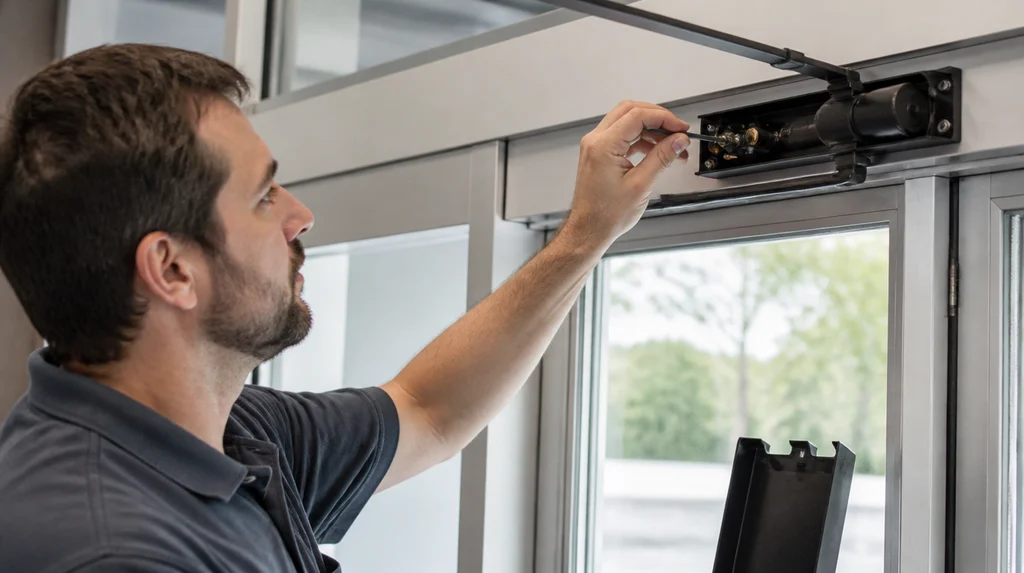
Pop the cover off and you will see two or three brass screws in a row on the end of the closer body. Those are the valves. Brands mark them with numbers or letters, but the jobs never change.
Here is the part that saves you a service call: each valve controls one part of the door’s travel, and turning the wrong one gives you a door that feels worse.
Direction is the same on all three: clockwise slows that part of the swing, counterclockwise speeds it up. Main speed covers everything from wide open down to about the last 10 degrees, latch speed picks up from there, and backcheck only does anything while the door is being shoved open.
A fourth valve means a delayed action closer, which holds the door open a few extra seconds so somebody with a cart or a wheelchair gets through.
How to slow a door that slams
Work in small steps, because these valves are more sensitive than they look.

- Get the right tool. Most closers need a small hex key, and older ones need a flat screwdriver. Turning one with pliers rounds it off, and then the closer is finished.
- Mark where you started. A pencil dab on the screw head lets you put it back if you overshoot.
- Turn the main speed valve clockwise a quarter turn. Clockwise always slows the door. Even an eighth of a turn changes the feel.
- Open the door all the way and let go. Count the seconds. You want a controlled close, not a drift and not a bang.
- Set the latch speed last. Use that second valve for the final few inches, quick enough to latch but not a slam.
Stop if the valve feels loose or you see oil. That is where adjusting turns into replacing.
The door closes but never latches
This is the most common closer call we take. Try the latch speed valve first, counterclockwise, a quarter turn at a time, so the door arrives with more push behind it.
If it still will not latch, the closer is not your problem. One cause is worth checking right here, because it is the only one that is really about the closer:
- The weatherstripping is too thick. New seals push back hard at first and can hold a door open a fraction of an inch.
Everything else at that point is the frame side rather than the closer: a strike plate that has moved, or a door that has dropped on its hinges. Our guide to fixing a door that won’t latch walks through how to tell those two apart and what each one takes.
4 problems no adjustment will fix
These are the ones we get called out for after somebody has already spent an afternoon turning screws.
- Oil on the door or the closer body. A closer is a hydraulic part, and the fluid inside is what makes it smooth. Once the seals let go, that fluid ends up on your door. It gets replaced.
- A bent arm, or screws pulled out of the frame. Yuval, one of our techs, sees this constantly: “A lot of the time I come in after a handyman who thought it was a smart idea to add a screw somewhere, and that just makes it worse.” Once the holes are chewed out, more screws hold nothing.
- Hinges that have given up. A door hanging out of square fights the closer all day, so we check both. Seven signs of storefront door trouble covers the rest.
- A closer that is too small for the door. Wide or heavy doors need more spring power than a small closer can give. Power maxed out and the door still stalls means the wrong closer, not a bad setting.
How fast should the door close?
Slow enough for somebody who is not quick on their feet.
The ADA Standards published by the United States Access Board put a number on it: from an open position of 90 degrees, a door must take at least 5 seconds to reach a point 12 degrees from the latch. Those standards also cap the pull needed to open an interior door at 5 pounds of force, and the Department of Justice 2010 ADA Standards carry the same requirement.
Two things people get wrong. That 5 pound limit is for interior doors, so wind and building pressure are allowed to make your front entrance heavier. On a fire rated door, the force is whatever the local fire official allows, because that door has to latch every time.
If your door has a push button, it is not a closer
A door with a blue push pad on the wall has a powered operator, a different machine with a motor and a control board. Owners assume a stalled accessible door needs reprogramming. Yuval’s numbers say otherwise: “Adjusting or program is 10% of jobs.” The other nine in ten are a failed part, usually the motor or the button, which is the ADA door repair work we do most. A twice yearly service visit prevents most of those emergency calls. A dead button is a different problem.
Frequently asked questions
Should the closer go on the inside or the outside of the door?
Inside, whenever the door allows it. Sun, rain, and the odd shopping cart are hard on a closer, and an outdoor unit ages faster than an indoor one. On most entrances that means a parallel arm on the inside face.
Why does my door only slam when the air conditioning is running?
Because your building is pressurized. Air pushed through the ducts has to leave somewhere, and it pushes against the doors on the way out. A door set perfectly at 8am can slam at 2pm, so set the swing while the system runs.
Is it safe to change the spring power myself?
Turning the power down is fine. Turning it up on a big door is where people get hurt, because a loaded spring can whip the arm around if a fastener lets go. A door needing more power than the closer can give is a sizing problem, so hand that one to somebody who does it daily.
Get the door working the way it should
If you have turned every screw and the door still slams or leaves the store open at night, the closer has stopped being an adjustment and become a repair. JDM Sliding Doors services commercial and storefront entrances. Send us a photo of the closer and we will tell you straight whether it needs a quarter turn or a replacement. Schedule a free repair estimate, or read more about our commercial door services.