Your door will not stay shut. It bounces back when you pull it to, or it only catches if you lift the handle and lean on it.
Almost none of these is a broken lock, which is what people buy first. Two small metal parts have stopped meeting, and only four things cause that. You can see which one you have in a minute, without unscrewing anything.
By the end you will know where to look for the cause, which fix goes with which cause, how to tell when the latch is worn out instead of misaligned, what I check before I move the plate on the frame, and why a busy door stops latching again a few months later.
I am Gal Cohen, field area manager at JDM Sliding Doors, and a latch that stopped catching is one of the calls we take most on a storefront entrance.
Key takeaways
- Watch where the latch stops before you touch anything. The fix depends entirely on that.
- If the latch misses the hole by less than an eighth of an inch, file the hole. Do not move the plate.
- A latch that arrives low means the hinges, not the strike plate. Moving the plate hides a sagging door for a few months.
- A two and a half inch screw through the top hinge into the wall framing pulls a dropped door back up.
- Moving the strike plate on a sagging door buys a season, then leaves two holes in the jamb.
Start by finding where the latch is actually hitting
Short answer: a door that won’t latch is almost never a broken lock. Two small parts just are not meeting.
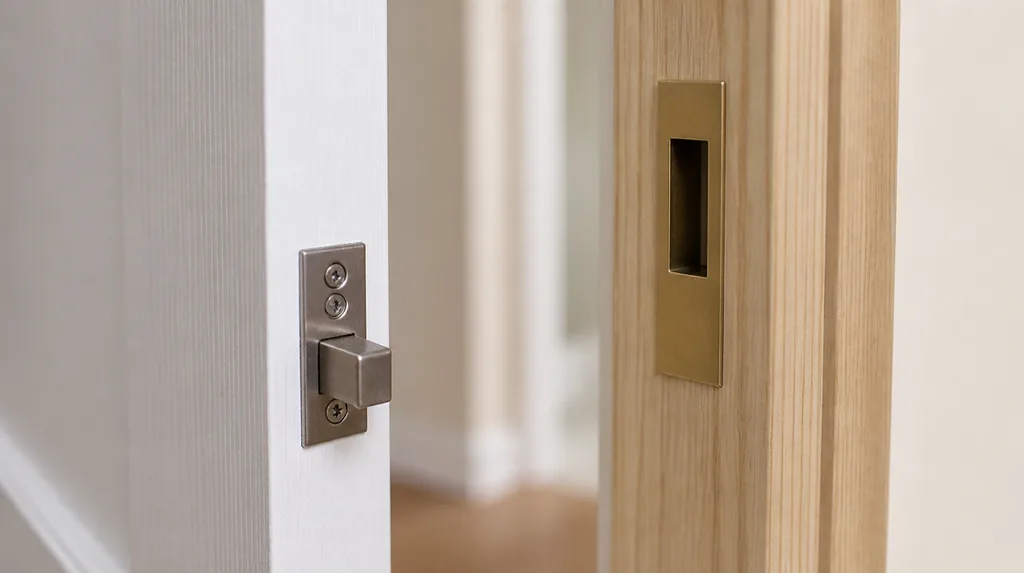
Open your door and look at its edge, below the handle. A little metal bolt sticks out, and it springs back when you press it. That is the latch.
Now look at the door frame across from it. There is a flat metal plate screwed on with a hole cut through it. That is the strike plate.
Closing the door is supposed to push that bolt into that hole. When the door will not stay shut, the bolt is arriving somewhere other than the hole, and there are only four reasons why.
- The plate on the frame sits slightly off. The bolt hits flat metal instead of the hole. This is the quickest one to fix.
- The door has dropped. Loose or worn hinges let the door sag, so the bolt arrives below the hole.
- The door swelled and sticks. It jams against the frame before the bolt ever reaches the plate.
- The bolt itself is worn out. It no longer springs all the way out. No amount of lining things up fixes that one.
How I know: you can see which one you have in about a minute, by watching where the latch stops against the frame. I will show you that test first, because every fix below depends on the answer.
Here is the part that saves you from drilling holes you did not need.
A door latch not catching is almost always a clue you can see. Close the door slowly and watch the latch as it reaches the frame. You want to know whether it arrives high, low, short, or not at all.
If you cannot see it, put a strip of masking tape over the strike plate and rub a little lipstick or a pencil edge on the latch bolt. Close the door once, and the mark on the tape tells you exactly where the latch is arriving.
Now read the mark:
| Where the latch stops | What that tells you |
|---|---|
| Below the hole | The door has dropped on its hinges |
| Above the hole | The frame or the top hinge has shifted |
| Beside the hole, toward the stop | The strike plate sits too far into the jamb |
| Short of the plate entirely | The door is binding on the frame before it gets there |
| Right at the hole, but it will not stay | The latch itself, not the alignment |
Two of those are a strike plate job and two of them are not, which is the whole reason this test comes first.
How to fix a door that won’t latch, in the order I would try it
Work down this list. Each one takes longer than the one above it, so there is no sense skipping ahead.
The strike plate hole is slightly off
If the mark is within about an eighth of an inch of the hole, you do not move anything. Take the plate off, clamp it, and file the opening out toward the mark until the latch drops in. A metal file and a few minutes is the whole job.
If the mark is further out than that, you are into a real strike plate adjustment: unscrew the plate, move it, and drill new pilot holes. Fill the old holes with a wood filler or a golf tee and glue first, or the screws will wander straight back into them.

The door has dropped on its hinges
A latch that arrives low is a hinge problem, not a strike plate problem. Open the door and push up on the outer edge. If it lifts, the hinges are loose.
Start with the top hinge, because that is the one carrying the weight. Tighten every screw, and watch for one that spins without biting, which means the wood inside is stripped.
Take one screw out of the jamb side and drive a longer one in its place, long enough to reach the framing behind the jamb. That one screw pulls the whole jamb in and lifts the latch back toward the hole.
For the size, Therma-Tru’s own installation walkthrough calls for #10 two and a half inch exterior grade screws to anchor a door to the jamb through the hinges.
The door swelled and sticks before it reaches the latch
If the door won’t close all the way, and the mark on the tape is short of the plate or missing entirely, the door is stopping against the frame first. Run a finger down the space between the door and the jamb, then mark the point where that space closes up. Sand that mark back until the door swings clear.
Then seal what you exposed, the same day it comes off. Simpson Door Company’s care and finishing guide is blunt about it: “Coat all six sides of every door, or your warranty will be voided.” Bare wood pulls in moisture and swells straight back to where it was, so the sanding you just did buys you one season.
When the latch is worn out, and no alignment will fix it
This is the cause the rest of the internet skips, and it is the one I want you to be able to rule out.
Push the latch bolt in with your thumb and let go. It should snap back out fast and sit proud of the door edge. If it comes back slowly, sticks halfway, or needs a nudge, the spring inside the lock is done. You can line that door up perfectly and it still will not stay shut.
Locks are built to a tested lifespan, and it is a real number. The Builders Hardware Manufacturers Association summary of ANSI/BHMA A156.2, the standard for the bored locks on most doors, says a Grade 1 lock has to survive one million cycles of opening and closing with a ten pound load pulling on it.
A builder grade lock on a door your family uses thirty times a day is working through that count a lot faster than the one on a guest room.

That same document gives you a second thing to feel for: a lever lock has to open with no more than 28 inch pounds of torque. That is light. If you are pushing the lever down hard to get the door open, the lock is already out of spec, and tightening the hinges will not bring it back.
4 fixes I get called out to undo
None of these are silly. They are all reasonable things to try, and they all cost somebody a second visit.
- Moving the strike plate on a door that has dropped. The latch finds the new hole for a season, then the door sags a little further and misses that one too. Now there are two holes in the jamb and the hinges still have not been touched.
- Driving long screws through every hinge at once. One screw at the top hinge pulls a sagging door up. Three of them pull the whole jamb out of square, and the door starts binding at the top instead.
- Filing the strike hole a little wider every year. Each pass makes the opening sloppier, and eventually the bolt sits loose in it. The door latches and then rattles every time somebody walks past.
- Buying a new lockset before checking the frame. If the old bolt still springs out properly, a new one arrives at exactly the same misplaced hole. Nothing changes except the bill.
The thread running through all four: work out which part moved before you change any part.
Why a busy door stops latching again a few months later
On a house door, you fix this once and forget it. On a door the public uses, it comes back, and it is worth knowing why before you pay for the same repair twice.
A storefront entrance gets opened far more often than a home door does, so the hinges wear and the door drops out of alignment much faster. When our techs see the same door twice, the answer usually stops being the strike plate and becomes the hinge itself.
On those openings we fit a continuous hinge that runs the full height of the door instead of two or three separate ones, and the sagging stops. Our guide to continuous hinges on commercial doors covers when that swap is worth it.
One more thing worth separating out. If your door has a closer on top and it drifts shut without ever pulling into the frame, that is a different adjustment on a different part, and door closer adjustment walks through it.
Frequently asked questions
The door stopped latching right after we painted it. Why?
Paint on the jamb stop or on the edge of the door adds thickness, and a latch only needs a fraction of an inch to come up short. Check the stop molding first, because painters coat it every time and nobody counts how many times it has been done. Scraping that stop back is quicker than touching the hardware.
The latch catches but the deadbolt will not turn. Same fix?
No, and do not treat them as one job. The deadbolt sits in its own hole several inches above the latch, so a door can drop just enough to bind the bolt while the latch still finds its opening. Look at the deadbolt hole separately and mark it the same way.
My door is fire rated and will not latch. Can I file the strike plate?
Leave that one alone. A fire rated door only does its job if it latches, and the hardware on it is listed as a set, so filing a plate or swapping in a part off the shelf is not a casual job.
We repair fire rated doors, we do not certify them. Have somebody look at that one rather than filing anything.
Why won’t my door latch on a bedroom door when the front door is fine?
Same three causes, different odds. A bedroom door won’t latch most often because the hinge screws have pulled loose, since interior doors hang on thin jamb stock that gives up a screw far sooner than an exterior frame does.
An interior door won’t latch from swelling as often either, because it is not taking weather on one face. Check the top hinge screws first on those, and the strike plate second.
How long does this take somebody who does it every day?
Most of them run ten to thirty minutes, including finding the cause. A dropped door that needs the hinges reset takes longer, and a worn out lockset is a parts job rather than an adjustment.
Get your door latching again
If you have tightened the hinges, checked the bolt, and the door still will not stay shut, you are past the point where another turn of a screwdriver helps.
JDM Sliding Doors repairs residential and commercial doors, and a latch that will not catch is a short visit. Send us a photo of where the latch is stopping and we will tell you whether it is the plate, the hinges, or the lock. Schedule a free repair estimate.