Your entrance door has started to drag. It catches on the floor, staff shoulder it open, and somebody has tightened the hinge screws once already.
A door that sags has hinges that can no longer hold it up. The hinge you buy next decides whether you are back here in a year. There are two kinds. The right one comes down to how many people pull that handle a day, not to the door.
By the end you will know how each hinge carries a door, which one suits a busy entrance, the three things our techs find on these calls, and what the hinge standards say about the difference.
I am Gal Cohen, field area manager at JDM Sliding Doors, and our crews handle commercial door services for stores, offices and property managers.
Key takeaways
- The two hinges carry the door differently. Three butt hinges hold it at three spots. A continuous hinge carries it along every inch.
- Traffic decides it, not the door. A commercial entrance gets opened many times more than a house door, so its hardware wears on a completely different schedule.
- Sagging is the tell we look for. A door scraping the floor or catching on the frame is almost always hinges giving up, not the door warping.
- Continuous hinges have their own standard. They are tested separately from butt hinges, not as a variation of them.
- Standard hinges are not wrong. On light interior doors they are cheaper, easier to find, and quicker to replace, and we say so.
How each hinge carries the door
Short answer: put a continuous hinge on any door the public opens all day. It runs the full height of the door, so the weight spreads along the whole edge instead of hanging on two or three small points. Standard hinges are fine on light doors and low traffic openings, and they are cheaper and easier to swap. On a busy storefront they bend, sag, and pull loose, and that is when the door starts dragging on the floor.
How I know: the field notes here come from Yuval, one of our elite technicians, who is on 20 to 30 doors a week and does most of our hinge upgrades. We also handle sliding door repair on the residential side, and this is the same walkthrough we give people on the phone.
When we walk up to a sagging door, the first thing we check is which part of the door is carrying its weight. That one detail explains most of what goes wrong later.
A standard butt hinge is a pair of small plates joined by a pin. A door gets two, three, or four of them down one edge. All the weight of that door presses on those few spots, and on the screws holding them.
A continuous hinge is one long hinge that runs the full height of the door, top to bottom. Some are geared, some pin-and-barrel, but the idea is the same: the load spreads along the entire edge. No single point takes the strain.
On paper that sounds like a small difference. On a door somebody opens ten times a day, it is. On a door the public pulls open every minute the store is open, it is the difference between a door we service once and a door we keep getting called back to.

How the two compare, based on what holds up
Owners usually open with the price of the part. We steer that conversation to weight and wear first, because that is what decides whether you are paying once or paying again.
| Continuous hinge | Standard butt hinges | |
|---|---|---|
| Where the load sits | Spread along the full height of the door | Concentrated at two to four points |
| Best fit | Entrances, storefronts, high traffic, heavy or oversized doors | Interior doors, offices, closets, light traffic |
| Common failure | Rare, and it shows up slowly | Bending, sagging, screws pulling out of the frame |
| Frame damage over time | Low, because no single spot is overloaded | Screw holes wallow out and stop holding |
| If hinge cutouts do not line up | Handles it, one continuous piece needs no matching cutouts | Door and frame prep must match |
| Replacing it | One piece, more labor up front | Swap a single hinge in minutes |
| Part cost | Higher | Lower |
| Security | No exposed pin to pull | Pins can be a weak point unless they are non-removable |
The 3 things we see every day on commercial door calls
These three come up over and over. If your door is doing one of them, you are not dealing with anything unusual.
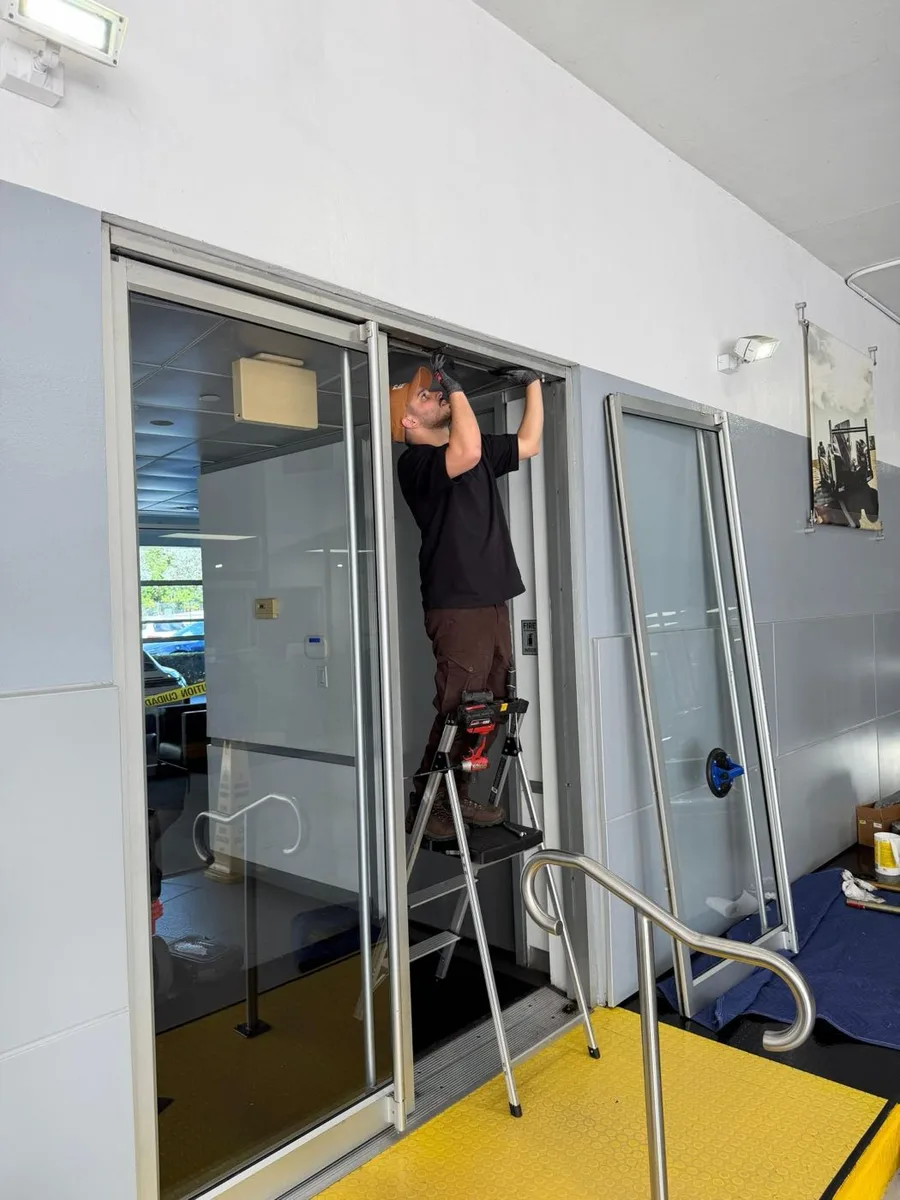
- The door scratching the floor. This is our number one commercial call. Yuval’s words: “On a storefront, the most common problem I see is the door scratching the floor because it is no longer aligned with the frame.” The owner almost always assumes the door swelled or the slab shifted. What we find is that the hinges dropped it. A commercial door gets opened many times more than a house door, all day long, so everything on it wears far faster.
- The closer and the hinges wearing out first. A house door has hinges and a lock. A commercial door adds a closer, the hydraulic arm up top that pulls the door shut when you let go. More moving parts under constant use means more that fails, and those two are the parts Yuval replaces most.
- Pivots and butt hinges bending under the traffic. This is the one that keeps bringing us back to the same address. Yuval: “Many commercial doors hang on a pivot or standard hinges, and under heavy use those bend and break.” Tightening the screws buys a few weeks. The holes are already worn, so the same door sags again, and the owner ends up paying us twice for one problem. The first sign is usually a door that will not latch, because the latch drops below the strike long before anybody notices the hinge.
That third one is why we stopped fixing the symptom. “What we do is upgrade the door to a continuous hinge, one hinge that runs the full height of the door from bottom to top, built for heavy-duty, high-traffic use,” Yuval says. “Once we install a continuous hinge, I honestly never get a callback on that hinge again.” Then we realign the door to the frame so it closes the way it should.
What the standards say, and why it matches what we see
We are not asking you to take our word for it. This is the part most people miss: continuous hinges are not a heavy version of a butt hinge. They are a separate product with a separate standard.
Butt hinges fall under ANSI/BHMA A156.1, which sets four grades: Grade 1 heavy duty, Grades 2 and 3 standard weight, and Grade 4 light weight. On a commercial opening, Grade 1 is the only one we let anybody put on.
Continuous hinges are covered by ANSI/BHMA A156.26, which adds abuse, overload, and vertical wear tests on top of cycle testing. Vertical wear is the sag test. Sag is the exact failure we get called out for, which is why that line in the standard always stands out to me.
The cycle numbers show the gap. SELECT Hinges reports that its geared continuous hinges have been proven in independent performance testing surpassing 25,000,000 cycles, and warrants them with no time limit. No butt hinge is sold on that kind of number.
One more thing we point out to property managers. The ADA Standards from the U.S. Access Board limit how hard an inside door may be to push or pull (rule 404.2.9). A sagging door rubs the frame and takes more force to open, so it can drift out of the rules without anyone changing a thing.
When we tell people to stay with standard hinges
A continuous hinge is not the answer to every door, and I do not sell them that way. Here is when we talk an owner out of one.
Light interior doors. An office, a stockroom, a restroom partition. Three Grade 1 butt hinges handle those for years, and we have never had a reason to upgrade one.
Tight budgets on low traffic openings. The part costs less and the labor is shorter. On a door that gets used a few times a day, the extra spend buys you very little, and we would rather put your money on the door that is actually failing.
Doors you want to service fast. One bad butt hinge is a ten minute swap with a part any supplier carries. A continuous hinge is one piece, so replacing it is a bigger job.
Historic or decorative openings. Sometimes the visible hardware is the point, and a full-length aluminum hinge changes the look of the door. We flag that before we order anything.
What people ask us about the cost
Pricing on a hinge upgrade moves with the door, so treat any number you read online carefully. On our own calls, the quote comes after somebody looks at the door, because these are the things that change it. Five things change it. How tall and heavy the door is. Whether it is aluminum or hollow metal. Whether the frame is already chewed up from old screws. Whether the closer needs replacing at the same time. And whether the door is fire rated, which is its own category, because the hinge has to be listed for that assembly.
Ask whoever quotes it to itemize: the hinge, any frame repair, the labor, and the realignment as separate lines. Then ask what happens if the door sags again inside the warranty. That question tells you a lot about who you are hiring, and on a continuous hinge the answer should come back without hesitation.
What we recommend, door by door
Public entrance, storefront, or anything with a closer on it: continuous hinge. This is the whole reason the product exists. If the door is already sagging and you have paid to fix it once, do not pay for the same repair twice.
Heavy, tall, or oversized door: continuous hinge. Weight is what kills point loading, and a tall door multiplies it.
Frame prep does not match the door: continuous hinge. A full-length hinge needs no matching cutouts, which is often the cheapest way out of a mismatched replacement door.
Light interior door, normal use: Grade 1 butt hinges. Spend the money somewhere it does something.
If you are picking hardware rather than fixing a specific problem, our guide to the best door hinges for heavy doors covers the other types. If your door is already giving you trouble, 7 signs you need storefront door repair will tell you how urgent it is.
Frequently asked questions
These are the ones store owners and property managers actually ask us on site, answered the way we answer them there.
What is a continuous hinge?
A continuous hinge is a single hinge that runs the entire height of a door instead of two or three separate hinges. Because it is attached along the full edge, the door’s weight spreads out rather than pressing on a few points. It is also called a piano hinge, and the geared type is the one most often used on commercial entrances.
Is a continuous hinge better than three butt hinges?
On a high traffic door, yes, and that is not a sales line. Butt hinges concentrate the load at a few spots, and under constant use they bend and the screws work loose, which drops the door out of alignment. That is the repair we keep getting called back for. On a light interior door, three Grade 1 butt hinges are plenty and cost less, and we will tell you that too.
Why does my commercial door drag on the floor?
Almost always the door has fallen out of alignment with the frame, and worn or bent hinges are the reason. Tightening screws in holes that are already worn does not hold, which is why the problem comes back. The lasting fix is heavy-duty hardware plus a realignment of the door to the frame.
Can you put a continuous hinge on an existing door?
Usually yes, and it is one of the reasons we reach for them. A continuous hinge does not need the old cutouts to line up. That makes it a good fix for a door and frame that no longer match, or one where the screw holes have worn out.
Are continuous hinges more secure?
They help. There is no exposed hinge pin to pull, and the full-length attachment leaves no gap to pry at the hinge side. Security still depends on the lock, the frame, and the glass, so treat the hinge as one part of the opening and not the whole answer.
Get your commercial door fixed once
If your entrance is dragging, sticking, or on its second hinge repair, the hardware is telling you what it needs. JDM Sliding Doors services commercial and storefront doors across Miami-Dade, Broward, and Palm Beach, and our techs are on these openings every day. Send us a photo or have us come look, and we will tell you straight whether the door needs a realignment or the continuous-hinge upgrade. If it is the cheaper fix, that is what we will say. Schedule a free repair estimate, or read more about our commercial door services.