You have decided you want the whole back wall to open, and now you are looking at five brands whose websites all say the same things. The prices are not on any of them.
Here is what separates them in practice: how the panels are hung, what the frame is made of, and whether the maker will build to your opening or only to their sizes. Those three decide how the door feels in ten years, and the marketing photos do not show any of them. If you are still choosing between formats, start with bifold against accordion, and if the opening already has a slider in it, compare that against the other sliding door types first.
By the end of this you will know which of the best bifold doors suits which job, roughly what each costs installed, and what to ask before you sign.
Which of the best bifold doors should you buy?
Marvin and LaCantina are the ones to beat on a wide opening, Origin for a slim aluminum frame, and JELD-WEN when the budget sets the ceiling. Pella sits in the middle and is the easiest to get serviced.
- Wide openings need a maker who builds to size, which rules several of these out.
- Aluminum frames give the most glass; wood-clad gives the warmest inside face.
- The hardware carries the whole panel weight, so it is the part worth paying for.
- A bifold patio door replacement into an existing opening costs far less than a new opening.
Key takeaways
- Panel count drives the price more than width does, because every fold is more hardware.
- Ask for the installed price, not the unit price; installation is a third of the job here.
- In a hurricane zone, check the impact rating on the exact configuration, not on the range.
- Replacement bifold patio doors can often reuse the opening, and you save most of the cost that way.
- Bifold hardware is brand-specific, so pick a maker with parts available locally.
1. Marvin Ultimate Bi-Fold Door
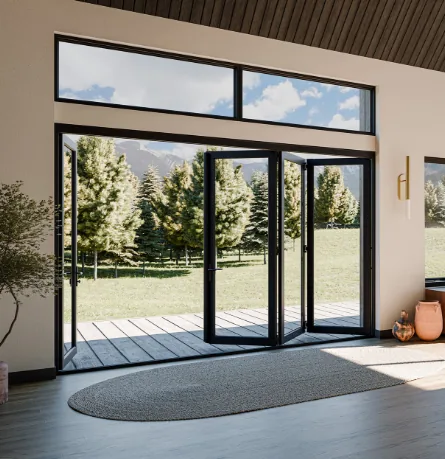
This is the one to look at when the opening is big. Marvin builds the Ultimate up to 55 feet wide, which is wider than most people will ever need and means a 20 foot opening is routine rather than special.
The outside is extruded aluminum. The inside is wood. So it takes weather on one face and looks warm on the other. The hardware is the quiet kind. That matters more than it sounds, because a heavy panel on cheap carriers announces itself every time you fold it.
Pick it when the opening is wide, the budget is real, and you want the inside face to be timber.
2. LaCantina Aluminum Wood Bi-Fold Door
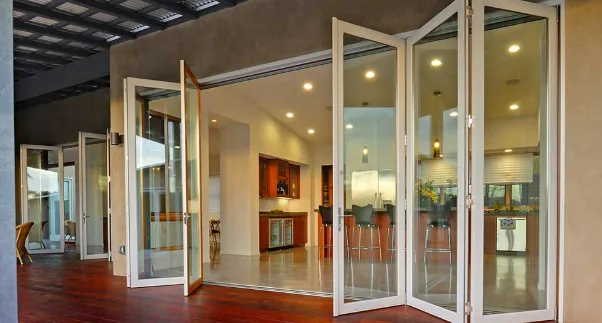
LaCantina runs the same idea as Marvin, aluminum outside and wood inside, on slimmer frames. Slim frames mean more glass for the same hole in the wall. That is the whole reason most people want a bifold.
Glass options run to dual glazing and Low-E coatings, and the doors are built to your sizes rather than to a catalogue.
Pick it when you want the most glass in the opening and a modern outside face.
3. Origin Bi-Fold Door (OB-72)
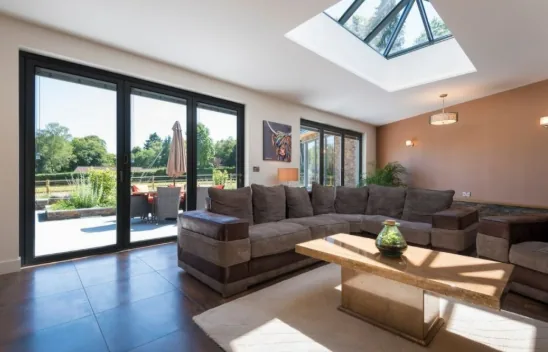
Origin is aluminum through and through, made in the UK. The OB-72 is the model that travels. It locks at eight points. The frames are thermally broken, which means a layer of insulation sits between the outside metal and the inside metal, so the frame does not carry heat straight through.
Color is the reason people pick it. Origin offers over 150 RAL shades, so the frame can match your trim instead of coming from a list of four.
Pick it when you want an all-aluminum door, a specific color, or the heaviest locking of the five.
4. Pella Scenescape Bi-Fold Patio Door
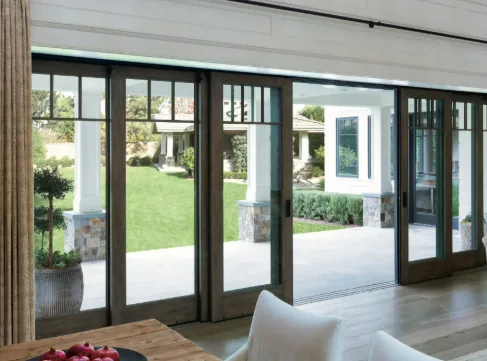
Pella’s frames here are fiberglass. Fiberglass moves less than aluminum or wood as the temperature swings, so the panels stay lined up. Glass goes up to triple glazing, and blinds can be sealed between the panes.
Read the fine print on those blinds first. Pella warrants blinds sealed between insulating glass for five years. The rest of the door gets far longer. We have written about what happens when a sealed-in blind fails.
Pick it for a mid-sized opening where you want a name with dealers everywhere.
5. JELD-WEN Bi-Fold Exterior Door
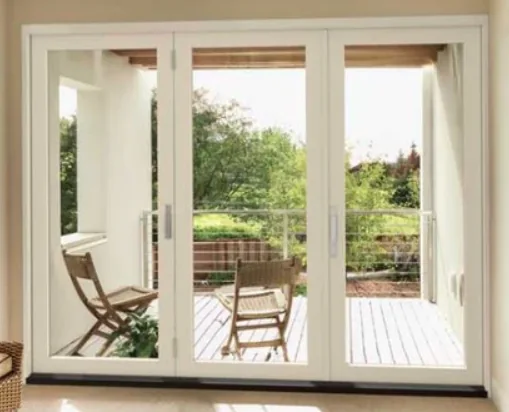
This is the budget entry, and it is a wood door rather than a metal one. The pine is treated all the way through against rot, water and termites. In Florida that is the part that matters.
Sizes are made to order and the hardware is stainless. So it is not a compromise on the parts that fail first. What you give up is the slim frame and the very wide opening.
Pick it when the budget sets the ceiling and the opening is a normal size.
What actually decides which bifold you buy
Four things decide this, and only one of them is how the door looks.
Frame material. Aluminum is strong and thin, so you get the most glass, and it needs a thermal break or it carries heat. Wood is warm inside and wants refinishing. Fiberglass moves the least as temperatures swing. Vinyl is cheapest and flexes on wide panels.
Glass and thermal breaks. In Florida the glass is doing most of the insulating work, and a frame with no thermal break undoes some of it. Ask for both numbers, not one.
Locking. A bifold has a lot of edge to secure. Multi-point locking is standard on the better systems and worth insisting on.
Opening size and fold direction. Count the panels, then decide which side they stack on. That stack sits against a wall when the door is open, so it has to go where there is nothing you need to reach.
Upkeep. Aluminum and fiberglass want washing. Wood wants refinishing on a schedule, and near salt water that schedule is shorter.
Bifold patio door replacement: swapping one into an opening you already have
Most of the bifold work we see is not a new opening. It is replacement bifold patio doors going into a hole that already exists, and that changes the arithmetic.
The opening is the expensive part, and you already own it. A new wide opening needs a header sized by an engineer, temporary support while it goes in, and finishing inside and out. Reusing an opening skips all of that.
Check the header first. A bifold stacks its whole weight onto one end of the opening when it folds back. A header sized for a standard slider may need reinforcing, even though the hole is already the right size.
The sill decides how it looks when it is done. A flush sill looks best and drains worst. A raised sill drains properly, and you step over it every day. In Florida a flush sill needs its drainage designed in, not added later.
Panel count is the price. Going from three panels to five is not a third more money. Every fold adds hinges, a carrier and another stile.
If you are in a hurricane zone, that decision narrows quickly, and it is worth reading the impact-rating question below before you shortlist anything.
For a closer look at the other end of the opening, read our guide to the best screen doors.
Frequently Asked Questions
Bifold vs accordion doors: what’s the difference?
A bifold folds flat against one side of the opening in two or more rigid panels on hinges. An accordion folds in many narrower segments, like a bellows, and stacks smaller. Bifolds are the stronger pick for a patio or a room you care how it looks. Accordions make sense for a closet, a laundry room, or a cheap room divider.
Is a bifold door better than an accordion door?
For most homes, yes. A bifold lasts longer, seals better, and takes outdoor use, which most accordion units do not. Accordions win on price and on very wide openings in tight rooms. They do not match a bifold on weather sealing, and in a humid climate that gap shows up fast.
What are the best bifold door brands in 2026?
Marvin, LaCantina, Origin, NanaWall and Andersen are the ones we install and service most. Marvin and LaCantina lead on aluminum and wood-clad. Origin is the aluminum pick a step below them. NanaWall is the specialist for a true folding glass wall. Andersen carries the best warranty of the five.
How much do bi-fold doors cost?
Installed, they run $800 to $1,600 per linear foot, depending on brand, material and glazing. A 12 foot bifold patio door from a mid-range maker like LaCantina comes to roughly $10,000 to $16,000. Premium systems from NanaWall or Marvin can pass $20,000. An interior bifold for a closet is far cheaper, often $300 to $1,200 fitted.
Are bi-fold doors good for hurricane zones?
Only the impact-rated ones are. Marvin, LaCantina and NanaWall all make bifolds with Miami-Dade and Florida Product Approval. On the coast, check the door carries HVHZ approval, which stands for High-Velocity Hurricane Zone. A standard bifold does not pass inspection there.
Talk it through before you commit
A bifold is one of the few door decisions that is expensive to undo. Opening width, floor track, panel weight and impact rating all get settled before anyone orders.
We install and service Marvin, LaCantina, Origin, NanaWall and Andersen, so we can tell you which system actually suits your opening rather than which one we happen to stock.
Book a consultation and talk it through with someone who installs these, or read our bi-fold vs accordion door comparison if you are still deciding between the two formats. We also handle sliding door repair and sliding door replacement.