A sliding screen door with a tear in it keeps tearing, and mosquitoes keep coming in until somebody puts new mesh in the frame. That usually takes about an hour.
Mesh is the woven sheet you see through. A thin metal frame holds it, and frame plus mesh is the panel you slide. A rubber cord pressed into a groove around the edge of that frame holds the mesh in. If that cord is the wrong size, the mesh will never pull tight.
The longer you leave the tear, the further it runs along the weave. A slack sheet then works the corners of the frame loose, until you are buying a new panel instead of a few dollars of mesh.
I will walk you through it step by step, so by the end you will know whether yours needs a patch or new mesh, which cord to buy, and how to roll it in without a ripple.
In this article:
- How do you rescreen a sliding screen door?
- Step 1: Decide between a patch and new mesh
- Step 2: Buy the right mesh and the right cord
- Step 3: Take the door out and strip it
- Step 4: Roll the new mesh in without a ripple
- Step 5: Trim it, hang it, and check the latch
- What does a new screen cost?
I am Gal Cohen, field area manager at JDM Sliding Doors, a screen door repair company in six states. If your door also drags, get it back on its track first.
How do you rescreen a sliding screen door?
Short answer: you rescreen a sliding screen door in five steps. Take the panel out of its channel and lay it flat, then pull the rubber cord out of the groove so the old mesh lifts off. Drop new mesh over the frame and roll a fresh cord in on top of it. Trim the edge, then hang the door back up.
- Match the cord before you buy it. Its thickness decides whether the mesh holds or ripples.
- Pick the mesh for what tore it. A paw and a no-see-um call for different weaves.
- Pull the mesh gently, never hard. Pulling hard drags the sides of the frame in and leaves it crooked.
How I know: the cord and mesh rules come from Phifer, which weaves the mesh. The removal and the hanging check come from Andersen’s care guide.
Step 1: Decide between a patch and new mesh
Look at the hole first, because the size of it decides between a patch and new mesh. A tear shorter than your thumb takes a stick-on patch from the hardware store. Anything longer, and any mesh that crumbles when you pinch a corner, needs new mesh.

The weave turns a small tear into a big one. A broken strand leaves its neighbors with nothing holding them in line, so the hole runs further along that line every time the door slides.
Check the frame before you spend anything, because new mesh cannot fix a bent one. Look along the closing edge with the door shut. If the daylight is wider at one end than the other, a new panel is the cheaper answer.
Step 2: Buy the right mesh and the right cord
Measure across the groove in the frame and buy a cord one size smaller. That is the rule from the company that makes both, and most people skip it entirely.
A cord that is too thin lets the mesh go slack. One that is too thick will not seat, and it pushes back out a week later. If you still have a piece of the old cord at the store, matching it by eye beats measuring.
The next question is which mesh. Plain fiberglass is the cheapest and the easiest to work with. A heavier fiberglass weave is half again as strong for a few dollars more. The vinyl coating on both goes through 1,200 hours of accelerated weather before it ships, so neither one rusts.
The pet weave takes claws, and the same maker rates it as its toughest. A tighter weave stops the insects small enough to walk through an ordinary screen. Buy the roll a few inches bigger than the frame all round.
Step 3: Take the door out and strip it
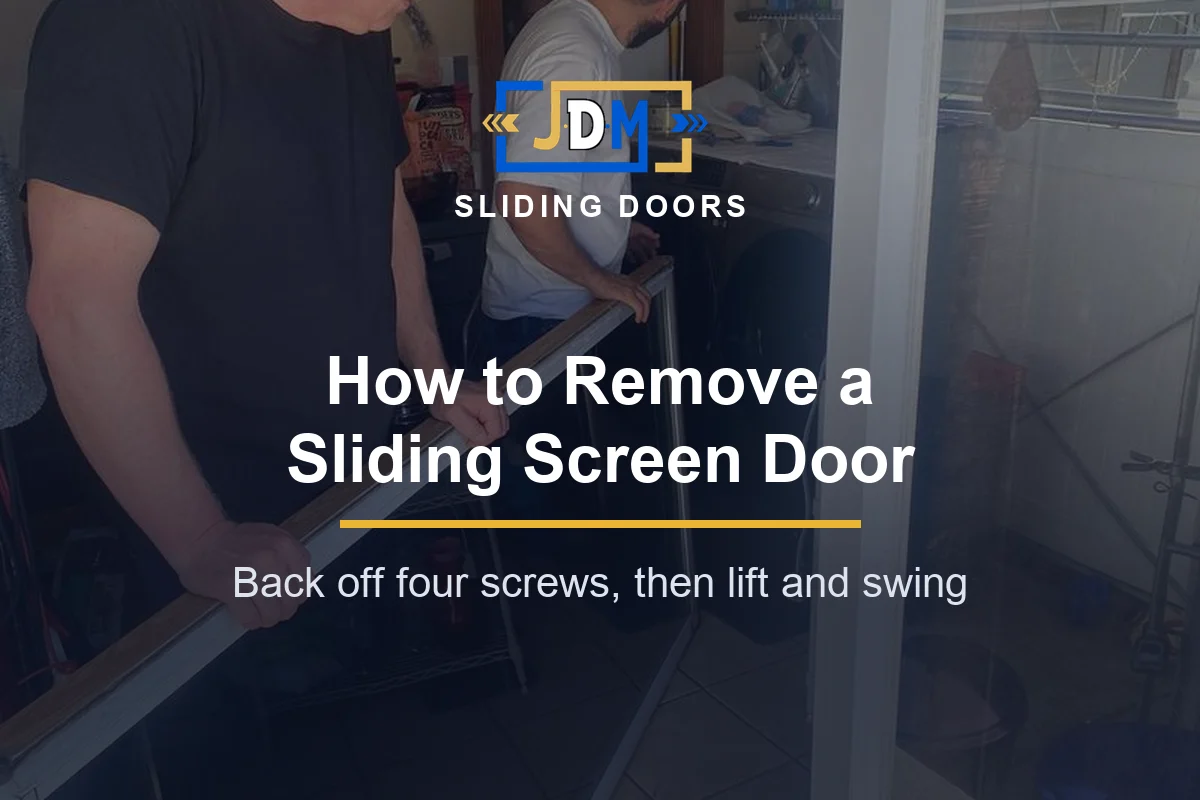
Take the door out by sliding it to the middle of the opening, lifting it, and pulling the bottom toward you. Andersen gives that order for its own screens, and the top clears as soon as the bottom is free.
If the bottom will not lift clear, look for the small holes along the bottom edge on the room side. A flat screwdriver in those holes winds the wheels up, which lifts the whole panel.
Lay the panel flat with the groove facing up. If you skip the handle and leave it on, the cord will not seat underneath it, so unscrew it now.
Lever one end of the old cord out of the groove with the same screwdriver. The whole length then pulls out in one piece, and the old mesh lifts off. Clean the sand out of the groove, because grit holds the new cord high and a high cord pops back out within a week.
Step 4: Roll the new mesh in without a ripple
Start with the new mesh laid over the frame, a couple of inches hanging over every side. Line the weave up square, so the little rows run parallel to the edges. A sheet laid on at a slight angle looks crooked from inside the house for years.
Tape the overhang down on two sides. Phifer suggests masking tape for exactly this, and it stops the sheet creeping while you work.
Press the cord into the groove with a spline roller, the cheap wheeled tool sold beside the mesh, or with a flathead screwdriver if you only have one door to do. Start halfway along one long side and work out to the corners. Press each corner down with the screwdriver.

Pull the mesh gently with your free hand as you roll. That is enough to lay the sheet flat. If you keep pulling harder than that, the two long sides of the frame come toward each other. A crooked frame leaves a gap you will be looking at every evening.
Step 5: Trim it, hang it, and check the latch
Take a utility knife and trim the overhang along the outside edge of the groove. Phifer’s own instruction is to cut toward the outside, away from the mesh you just fitted, because a blade that wanders inward cuts the new sheet.
Hang the panel top first into the upper channel, then set the bottom wheels on the lower one. Screw the handle back on.
Close the screen to within an inch of the side of the frame and look along that edge. Andersen’s guide asks for the same check: the space should be the same at the top as at the bottom.
What happens if the latch still misses? The panel is sitting low or high by a few turns of one wheel. Wind the wheels through those small holes until the latch catches on its own.
What does a new screen cost?
A sliding screen door screen replacement costs a few dollars in materials if you do it yourself, and our service call is $125 if we do it for you. The tools cost more than the mesh, and you buy them once.
Our Door Care members pay nothing for the visit and take 15% off the repair. The job itself depends on the size of the panel and the mesh you pick, so we quote it at the door rather than from a sheet.
If you wait, the bill changes shape. A screen replacement for a sliding door stops being mesh and becomes a new panel, several times the price.
How we rescreen a door
Yuval, our elite technician, keeps the rule short: “If it’s parts, it’s replaced. If it’s a door, we repair it.” Mesh is a part, so the frame stays.
A rescreen takes us roughly two hours on a standard slider, and we can often come the same day. We carry several weaves on the truck, so you pick one while we are standing there.
Now you know what good looks like. Once the cord is in and the wheels are set, the door slides with one hand and the latch catches first time. You end up with a screen you stop noticing, and your evenings back with the door open.
Our work carries 6 months on the parts we supply and 1 year on our own installation. We handle screens, rollers, tracks, locks and handles.
Key takeaways
- The cord costs under a dollar and decides the whole job, so buying it blind is the shortcut that costs you the afternoon twice.
- Mesh is priced by the foot either way, which makes the tougher weave the cheapest upgrade on the door.
- A frame that is already bent will not hold new mesh tight, so the frame check comes before the shopping trip.
- A ripple in the sheet and a crooked frame both come from how hard you pull, not from the mesh you bought.
Frequently asked questions
What size screen door spline do I need?
Spline is the trade word for that rubber cord. It comes in steps between about an eighth and a sixth of an inch. With no old piece to match, buy two neighboring sizes and return the one you do not use, because a second trip costs more than the spare cord.
How much does it cost to replace the screen on a patio door?
The materials are a few dollars either way, so the real question is whose afternoon it is. A screen shop is usually the cheapest hired option, as long as you can carry the panel there yourself.
Can I replace the screen in a sliding door without taking the door out?
You can replace it in place, badly. The groove runs all the way around the frame, and the two edges nearest the door frame are out of reach while the panel hangs there. Take the five minutes and lift it out.
Get the bugs out before you open the house up
Is the mesh on your slider torn, slack or chalky? The frame around it is almost certainly still fine.
JDM Sliding Doors handles screen door repair across South Florida and our other markets. We put new mesh in screen doors, and we fix the wheels, channels and locks around them.
Send a photo of the door and the closing edge. We will tell you whether it needs mesh or a frame. Schedule a free repair estimate.