A torn screen has to come off the door before anybody can put new mesh in it. The same goes for a screen that drags. Sliding screen door rollers live in the bottom edge of the sliding piece, a sheet of mesh in a light aluminum frame called a panel, and nobody reaches them while it hangs in the opening.
Most people lift before anything has been loosened. If you keep pulling at one corner, the frame bends, and a bent frame never shuts tight again. That five minute job now costs you a new screen panel.
This guide walks you through it step by step, in the order it happens at the door. By the end you will know which side of the glass your screen hangs on, how to loosen the four wheel screws, how to lift the panel out, what to check while it is off, and how to put it back so the latch still catches.
I am Gal Cohen, field area manager at JDM Sliding Doors. This is the screen, not the heavy glass panel beside it, which comes out a different way.
Key takeaways
- A sliding screen door carries a small wheel at each of its four corners, and all four wheels have to be wound up into the frame before the panel lifts out.
- The screen hangs on the outside of the glass door, so the bottom of the panel swings out toward the patio and never into the room.
- A screen panel comes out upward, because the top track is cut deeper than the bottom one, and that extra height frees the bottom edge.
- An aluminum screen frame twists if you carry it by one corner, so grip both upright sides and lay the panel flat once it is out.
How to remove a sliding screen door, in four moves
Here is how to remove the screen from a sliding glass door:
Short answer: loosen the four wheel screws, lift the panel straight up into the top track, swing the bottom edge out toward the patio, then lower it clear of the bottom track. You turn the screws with a screwdriver, and keep a butter knife beside you in case a wheel catches on the way out. Those should be the only tools you need.
- Loosen the wheel screws at all four corners.
- Lift the panel by both upright edges, up into the top track.
- Swing the bottom edge out toward the patio.
- Lower it and lay it flat, face down.
Those four moves are how to take a sliding screen door off any standard patio frame.
Where that comes from: the makers print the same sequence in reverse as the way to fit one. JELD-WEN’s patio door guide has you wind every wheel up into the frame before the panel moves. Andersen’s screen instruction sheet has the installer push the panel up into the top of the frame, bring the bottom in, then set the wheels down on the bottom track.
The checklist below runs the whole job: what to pick up, the four moves, and what stops a panel.

Step one: see which side the screen hangs on
Look at where the screen runs. On a patio door it rides in its own track outside the glass. JELD-WEN’s aluminum patio door guide says it in one line: the insect screen is mounted on the exterior side of the operating panel.
The next question is where that leaves you standing. The bottom of the panel swings out over the patio, the walkway or the balcony rail. The same guide tells you to take care on the outside of a patio door above ground level.
A ground floor screen is a one person job. A balcony screen needs two people.
Step two: loosen the wheel screw at every corner
Slide the screen halfway open and look at the corners. Screen door adjustment screws sit one to a corner, on the narrow edge of the frame or behind a little hole on its face. That screw raises or lowers the wheel inside. Most guides name the bottom two, and there are four.
Every turn pulls one wheel further up into the frame. You need that gap under the panel to lift it out. JELD-WEN asks for quarter turns, and warns that some rollers need their two screws turned in opposite directions to move the wheels the same way.
That is why one corner can seem to do nothing. Which way the screw moves your door is worth knowing before you start.
Two things get in the way here. A rubber seal sometimes covers a screw, so pull it back far enough to reach the head. A screw that will not turn has corroded in place, which is ordinary near the coast. Give it penetrating oil and ten minutes rather than a bigger screwdriver.
Step three: lift the panel out
Take the panel by both upright edges, not by the handle and not by one corner. Lift it straight up into the top track, as far as it goes, and the bottom edge clears the raised lip of the bottom track.
With the panel held high, bring the bottom edge out over the patio. Most doors swing clear with nothing under them. If a wheel catches on that lip, slide the butter knife under it and lift it over, the move JELD-WEN prints for a tight door. Then lower the panel out of the top track and carry it clear.
Set it down flat, on the floor or across a table. A screen left leaning against a wall twists under its own weight, and what you pick up an hour later no longer fits the opening.
Step four: check the rollers and the mesh while it is off
The panel is off, and this is the only time anyone can see the parts that make it work. The photo below shows the panel flat on a bench, with new mesh going in.
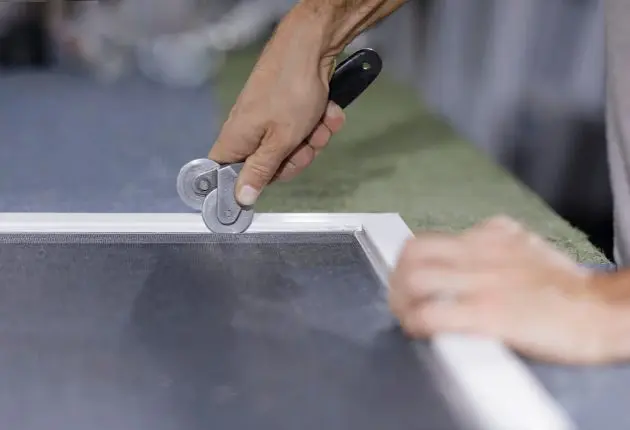
Photo: JDM Sliding Doors.
Spin each wheel. One that grinds, wobbles or will not turn is finished, and new wheels cost a few dollars against a new panel.
Look at the mesh too, and at the rubber cord that holds it in its groove. Mesh pulled loose at one corner rolls back in. Mesh that is brittle all over tears again the next time a dog leans on it.
Now vacuum out the bottom track and the top one. The longer you leave grit in there, the harder the door runs. Keep oil and spray out of the bottom track, where a wet surface collects sand and sets like paste. Put the silicone on the wheels instead, the same rule that governs cleaning a patio door track.
When the screen will not come out
Sometimes the panel stays put with every screw backed off. Check these four causes before you pull any harder, because if you keep forcing it the frame bends.
Paint is the first. On a door nobody has opened in years, paint seals the screen frame to the door frame, and a utility knife run down the edge breaks it. The second is a small tab or screw up in the top track, fitted to stop the panel lifting out, and it undoes with a screwdriver.
The third is a settled opening, where a house that has moved pinches the panel between the two tracks. Freeing that one means taking the top track off, which is where most people should stop. The fourth is a wheel that has broken apart inside the frame and jammed against the track.
A top hung screen is its own case. Its weight hangs from the top track and the bottom edge only runs in a guide, so that edge comes out first.
Putting it back so the latch still catches
Clean both tracks first. Then reverse the moves, wheels still wound up: top edge into the top track, bottom edge in over the bottom one.
Get the panel the right way round first. A screen that slides is not the same as a screen that latches. The latch lever belongs on the inside where your hand reaches it, and the wider edge of the frame belongs at the bottom.
Set the wheels last, a quarter turn at a time, until the panel hangs level and rolls freely. JELD-WEN puts the target plainly: as low as possible, just high enough to avoid drag.
What you get if we take it off for you
A technician carries the parts in the van, so the panel comes off and goes back on in one visit. We measure your panel and your old wheel on site, because screen wheels are not standard between brands. Our work carries 6 months on the parts we supply and 1 year on our own installation.
Frequently asked questions
Do I have to take the glass door out first?
No. The screen runs in its own track outside, so you can take a sliding screen door off with the glass door shut and locked.
Can I leave the screen off for a while?
You can leave it off, and plenty of people do between a tear and a repair. Keep the panel flat and out of the sun. One line the makers print is worth repeating: a screen will not stop a child or a pet falling through it.
Will WD-40 free a stuck adjustment screw?
WD-40 frees a stuck screw. Put it on the screw head, give it ten minutes, then try again. Keep it out of the track, because the oily film it leaves holds sand.
Get the panel off, or get it fixed properly
A screen forced out once usually reaches us bent, and a bent frame is a replacement, not a repair. If the panel is fighting you, stop there.
JDM Sliding Doors handles sliding door repair, screens, rollers, tracks and locks across South Florida and our other markets. Send a photo of the panel corner and we will tell you what it needs. Schedule a free repair estimate.