Two screws in the bottom of a sliding glass door, one at each end, set how high it sits. Each screw raises or lowers a small wheel under the door. So you can usually fix a stiff door yourself with a screwdriver, and skip buying new parts.
If you leave it and keep pushing, the bottom of the door grinds a groove into the metal track. Then you pay $395 or more for a new track.
I will walk you through it step by step, so by the end you will know where the adjustment screws are, which way to turn the screw on your door, and how high the door should sit.
In this article:
- How do you adjust a sliding glass door?
- Step 1: Has your sliding door dropped?
- Step 2: Where are the adjustment screws?
- Step 3: Which way do you turn the screw?
- Step 4: Lift the door and turn a quarter at a time
- Step 5: How high should the door sit?
- Step 6: How do you adjust the latch on a sliding glass door?
- Should you use WD-40 on a sliding glass door?
- When will a turn of the screw not fix it?
I am Gal Cohen, field area manager at JDM Sliding Doors, a sliding door repair company in six states. If your door is noisy as well as stiff, read why a sliding glass door makes noise first.
How do you adjust a sliding glass door?
Short answer: lift the bottom of the door with one hand, turn the screw at the low end 1/4 turn with the other, then slide the door to test it. Repeat until the door clears the track and the strip of daylight down the side of the frame is as wide at the top as at the bottom.
- Find the screws before you buy anything. Most sliding glass doors hide them behind small plastic caps near each bottom corner.
- Test the direction on your own door. The makers disagree about which way raises it.
- Set the door as low as it goes without scraping. A sliding glass door set too high lets rain in under it.
How I know: the steps come from the care guides the door makers publish, Andersen’s gliding patio door guide and JELD-WEN’s patio door guide. The rest comes from our own repair calls.
Step 1: Has your sliding door dropped?
Yes, if the bottom scrapes the track, the door leans in the frame, or the lock misses its catch. With the door almost shut, if the strip of daylight down the side is wider at the top than the bottom, the far corner has dropped.
A door that rumbles along its whole length is not the same as a dropped door. That noise usually means a worn wheel, called a roller, and raising a broken roller only lifts the damage. Both wheels on the roller below have rusted flat. You will turn the screw in the middle of its bracket.
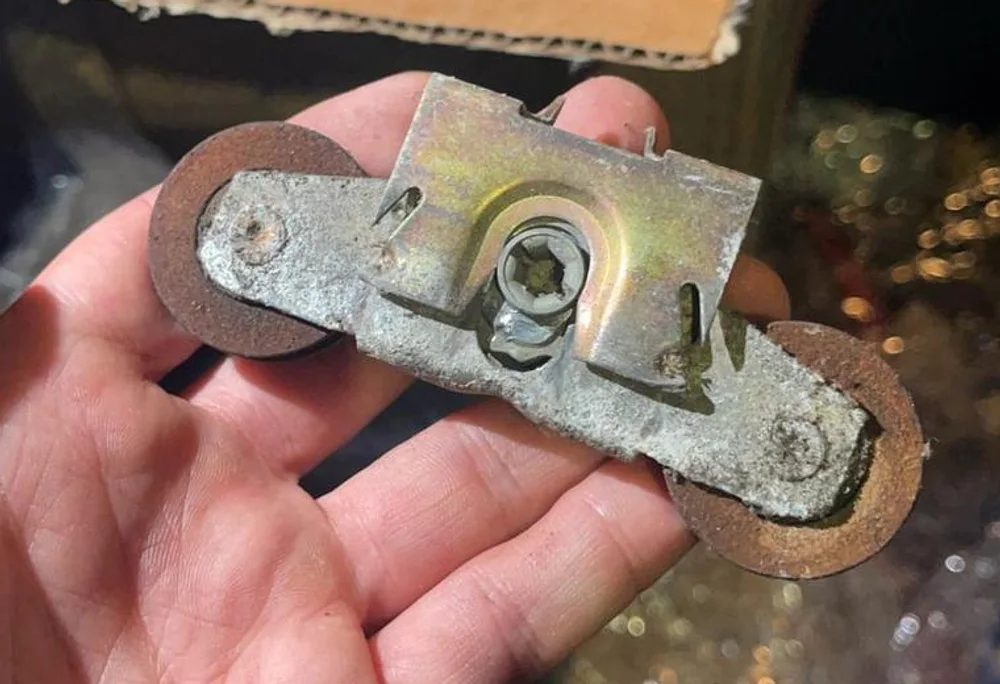
Photo: JDM Sliding Doors, from our own repair calls.
The longer you leave a flat roller in, the more it scrapes the track. A $375 roller job turns into a $495 job once the track needs work too. Read the signs your rollers are worn out before you start.
Step 2: Where are the adjustment screws?
The adjustment screws sit near the two bottom corners of the door that slides. The fixed door beside it has none. Look on the room side for a small plastic cap at each end, and pry it off with a flat screwdriver.
Some doors hide the screw in the end of the door. Others carry two screws close together, and JELD-WEN’s guide for its vinyl doors says to turn only the lower one. The upper screw holds the roller on.
Use a hand screwdriver, because JELD-WEN tells owners not to use a drill. The next question is which way to turn it.
Step 3: Which way do you turn the screw?
You find out which way your screw turns by testing it. Turn one screw 1/4 turn clockwise and look at the strip of daylight down the side. If it moved the way you wanted, keep going. If not, go the other way.
Most people guess wrong here, because the door makers disagree. Andersen’s guide says clockwise raises its doors. JELD-WEN’s guide says clockwise lowers the door when the screw sits behind a cap, and raises it when the screw is in the end of the door.
Step 4: Lift the door and turn a quarter at a time
Lift the bottom of the door while you turn, because a roller carrying the door’s weight fights the screw. JELD-WEN’s guide gives that order.
Turn 1/4 turn, then slide the door open and shut. Andersen’s guide says to move one notch at a time and check the door after each one. Expect to raise one end and lower the other to stop a lean.
If the screw will not turn with the weight off, stop and call a technician. A forced screw can lose its thread.
Step 5: How high should the door sit?
Set the door as low as it will go without scraping the track. JELD-WEN’s guide says to raise it just high enough to clear the track. The rubber seal along the bottom of the door should still be hidden when the door is shut.
A door set higher than that leaks every time a summer storm pushes water against it. The picture below shows a sliding glass door at three heights. Each one does something different to the track and the seal.

Slide the door shut to 1 inch from the side of the frame, the check Andersen’s guide gives. The strip of daylight should be the same width from top to bottom. Pella’s roller instruction asks for the same thing: the edge of the door standing straight beside the frame.
Once it passes, you have a door that rolls with one hand, closes flush and keeps the rain outside.
Step 6: How do you adjust the latch on a sliding glass door?
You adjust the latch on a sliding glass door by turning 1 small screw in the metal catch on the side of the frame. The lock is a hook on the door, and when the door drops the hook drops with it.
The height fix often cures the lock by itself. About 1 in 5 of the lock calls we run turns out to be a door out of line, not a broken lock.
If it still feels loose, Andersen’s guide says to turn the catch screw counterclockwise for a tighter fit. Otherwise read why a sliding glass door won’t lock.
Should you use WD-40 on a sliding glass door?
No, you should not use WD-40 on the track of a sliding glass door. WD-40 is the spray oil in the blue and yellow can, and oil in the track holds sand. Andersen’s guide says to keep every lubricant off the track, because the rollers then slide instead of rolling.
Vacuum the track and wipe it with a damp cloth first. If you skip that, a raised door still scrapes over the grit. Our guide to cleaning sliding door tracks covers what the rollers can take.
When will a turn of the screw not fix it?
A turn of the screw will not fix it in 3 cases: a broken roller, a bent track, or a screw that spins without moving the door. In each case the door scrapes at every setting. A door that has come off its track needs that fixed first.
When you call us, our tune-up covers the whole job: we clean the track, spray the rollers, set the height and line the lock up with its catch. It typically runs $225 on a standard door and $295 on a large or heavy one. If a roller has failed, we give you a flat-rate price in writing before any new part goes in.
You end up with a door that slides with one finger and locks on the first push.
Frequently asked questions
Can you adjust a sliding glass door without taking it off?
Yes. The screws sit in the bottom corners while the door hangs in place. You only take the door out to replace a roller.
How do you adjust a sliding screen door?
You adjust a sliding screen door the same way. Its small rollers each have their own screw along the bottom edge, and our guide to putting a sliding screen door back on track shows them.
Get your door rolling and locking again
JDM Sliding Doors handles sliding door repair in six states. Tell us what the door does, and we will tell you whether it needs a turn of the screw or a new part. Schedule a free repair estimate.