Your sliding glass door has started making a noise every time it opens. It squeals, or it grinds, or something thumps at the same spot in the track, and it is loud enough that people in the room look up.
The noise is the useful part. Each sound comes from a different stage of the same wear, and the one you are hearing tells you whether this is a five dollar fix now or a track replacement later. Getting it wrong, usually by spraying something into the track, is what turns the cheap stage into the expensive one.
By the end you will know what each sound means, the five things we find on noisy door calls, the track advice to ignore, and when the noise means stop using the door.
I am Gal Cohen, field area manager at JDM Sliding Doors, and sliding door repair calls like these are most of what our techs do.
Key takeaways
- Noise is a timing signal, not a cosmetic one. A door that squeals is early; a door that grinds is already cutting its own track.
- Worn rollers are the single most common cause. Cleaning and lubricating will not fix a wheel that has already worn down.
- Do not spray lubricant into the bottom track. Andersen’s own care guide says it makes the rollers slide instead of roll.
- Roller replacement averages about $405 on a standard two-panel door and about $635 on a large or heavy-panel one. Waiting until the track is chewed pushes that to $1,000 to $2,500 for a full track replacement.
- Salt corrosion is a shoreline problem, not a metro-wide one. A few miles inland, the culprit is grit and pollen instead.
What each sliding door sound means
Short answer: A sliding glass door makes noise because the rollers it rides on are dry, worn, or grinding through trapped grit. The sound tells you which one, and how much time you have left before the repair gets bigger.
- Squeal or chirp: a dry roller or a dry contact point. The cheapest stage to catch it.
- Grinding or crunching: sand under the wheels, or a wheel worn down to its metal hub. This is the sound that eats the track.
- Rumble or thumping: a flat-spotted or seized wheel skidding along instead of rolling.
- A pop at the same spot every time: damage in the track itself, not the roller.
- Rattle only when the door is shut: worn weatherstripping or a loose panel, not a roller problem at all.
How I know this: our elite technician Yuval repairs 20 to 30 sliding doors a week across South Florida, and he sorts these calls by sound before he ever sees the door.
Every noisy door falls into one of a handful of sound patterns, and each points at a different part. Match yours to the table before you touch anything.

| What you hear | When you hear it | What it usually is | How urgent |
|---|---|---|---|
| High squeal or chirp | Anywhere in the slide, worse when dry | A dry roller bearing, or the wheel edge dragging on a dry track | Low. Best time to act |
| Gravelly grinding or crunching | Whole length of the slide | Sand and grit packed under the wheels, or a wheel worn to its metal hub | High. This is cutting the track |
| Deep rumble or repeated thump | Every rotation of the wheel | A flat-spotted or seized roller that skids instead of turning | High. The wheel has stopped rolling |
| A single pop or clunk at the same point | Always the same spot in travel | A dent, high spot, or backed-out screw in the track | Medium. The track needs a look |
| Scraping up at the top of the door | Near the end of the slide | The panel has dropped and the top rail is rubbing the head stop | Medium. Alignment issue |
| Rattling when the door is closed | On windy days, or when you shut it | Worn weatherstripping or a loose panel, not the rollers | Low, but it leaks air and water |
That last row matters because it saves people money. A rattle with no sliding noise is almost never a roller job. We cover that side in why your sliding glass door lets in drafts, water, and bugs.
The 5 things we find on noisy door calls
These are in the order we run into them, not in the order the internet lists them.
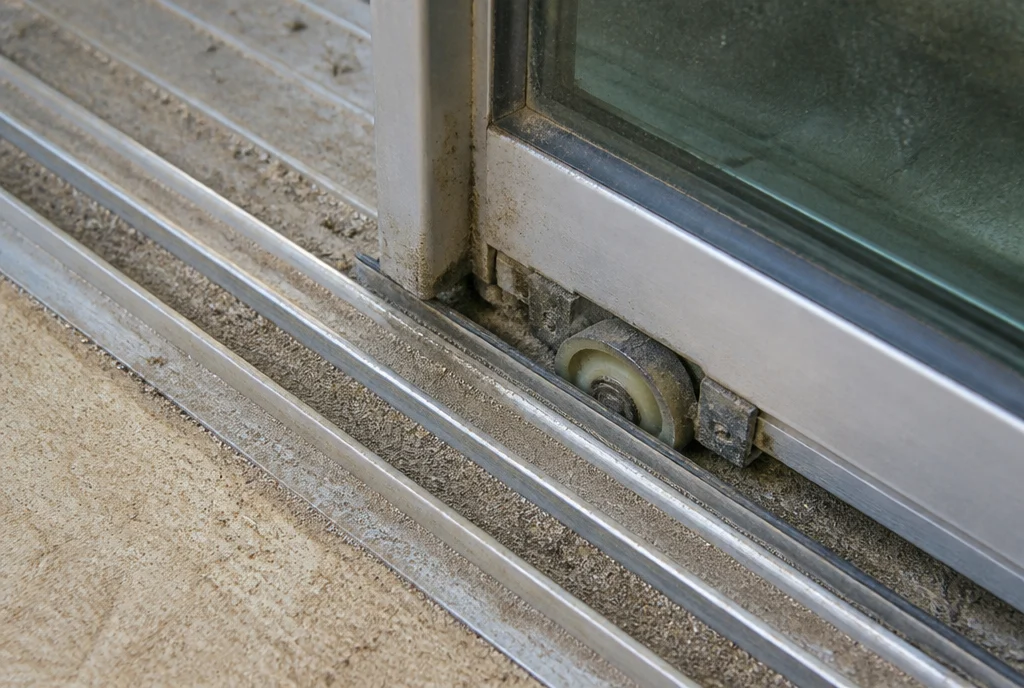
- Worn rollers, and no amount of cleaning fixes them. Yuval puts it plainly: “A lot of people think they just need to clean and lubricate the door and it will glide again. Most of the time that is not enough.” Once the wheels are worn, the door drags and complains no matter how clean the track is. Full symptom list in signs your sliding door rollers are worn out.
- Grit packed hard into the bottom channel. Sand, pollen, and pet hair compact into a paste in the track. The wheels roll over it and you get the crunching sound. This one really can be fixed with a vacuum, which is why it is worth trying first.
- A track that has already been cut. Keep sliding on dead rollers and the metal starts carving the aluminum. Yuval’s rule: “Replace the rollers on time and you usually do not need a new track at all.” Catch it late and the track comes out too. See damaged sliding door tracks.
- A panel that has dropped out of square. Houses settle. The frame shifts, the panel drops, and the top rail starts scraping the head stop while the bottom binds. It sounds like a roller problem and it is not. More on that in what to do when your sliding glass door won’t slide easily.
- Corroded hardware on homes near the water. Rusted roller housings seize, and a seized wheel skids. On shoreline properties we fit corrosion-resistant parts so the repair actually lasts.
Pocket doors make their own version of this sound from inside the wall cavity, where you cannot see the hardware at all. That is a different job, covered under pocket door repair.
The track advice you should ignore
Nearly every article about a noisy sliding door tells you to spray lubricant along the bottom track. The manufacturers say the opposite.
Andersen’s own Gliding Patio Door Care and Maintenance Guide is direct about it: “Do not use lubricants on the track itself; this will cause the rollers to slide, not roll.” A wheel that slides instead of rolls develops a flat spot, and a flat-spotted wheel is exactly what produces the rumble in the table above. The spray quiets the door for a week and then makes the problem permanent. It also turns the track into flypaper for sand.
Clean the track instead. If a lubricant is called for, it belongs on the roller and the hardware, and it should be a non-oil-based product, never WD-40 or anything oily. Our guide on cleaning and lubricating sliding door tracks walks through the cleaning side in detail.
What you can safely check yourself
Two checks are genuinely low risk. Anything past them involves lifting a heavy glass panel, so it belongs to a technician.
- Vacuum the bottom track, then wipe it dry. Use a crevice tool along the full length, then a stiff brush with warm soapy water on anything caked on, and let it dry. Keep your fingers clear of the rollers. If the sound was a crunch and it goes quiet, that was your answer.
- Watch and listen for where the sound repeats. Slide the door slowly, all the way, twice. A noise that happens at one fixed point is a track defect. A noise that repeats evenly is the wheel turning. Noting which one you have saves the technician time and saves you a diagnostic pass.
If the door is still noisy after a clean track, stop there and call a licensed professional. The panel on a South Florida patio slider is heavy, often impact rated, and usually takes two people to lift safely. Rollers, tracks, and panel removal are not homeowner work.
What it costs once a pro is involved
These are our real South Florida ranges as of August 2026. They are estimates, not quotes, and they move with door size, glass weight, and how long the door ran noisy.
| The job | Typical range |
|---|---|
| Door alignment or height adjustment | $400 to $550 |
| Roller replacement, standard two-panel door | about $405 |
| Roller replacement, impact-rated or multi-panel | about $635 |
| Track cleaning, straightening, or capping | $500 to $1,200 |
| Full track replacement | $1,000 to $2,500 |
The gap between the first row and the last row is the whole argument for calling early. A squeal is a $405 conversation. The same door left grinding for another year is a $1,000 to $2,500 one, because the rollers have machined a groove into the track and new wheels will not sit level in it. Always get a written, itemized quote before work starts. The full price list lives in how much it costs to fix a sliding glass door.
Why doors near the water go noisy sooner
Salt matters, but only where salt actually reaches. Airborne chloride is heaviest within the first few hundred yards of open water and drops off quickly inland, so a condo on the Intracoastal and a house in Weston are not the same case.
On shoreline properties, roller housings and screws corrode and seize, and Yuval sees those doors need new rollers every 2 to 5 years. Inland, a set commonly lasts 5 to 10. Away from the salt band the noise driver is different: construction dust, pollen, and dry-season grit grinding in an aluminum channel. Same sound, different fix, which is why we do not put marine-grade hardware on every door we touch.
FAQ
Why is my sliding glass door suddenly loud?
Something changed under the panel: grit worked into the track, a roller bearing dried out or seized, or a wheel finally wore through. A sudden grinding noise after months of quiet operation usually means a wheel has failed rather than that the track got dirty.
Will WD-40 stop my sliding door from squeaking?
No, and it makes things worse. Oil-based sprays attract sand and grit, and manufacturers including Andersen say not to put lubricant in the track at all because it makes the rollers slide instead of roll. Clean the track and treat the hardware with a non-oil-based product instead.
Does a grinding sliding door mean I need new rollers?
Usually yes. Grinding is the sound of a worn wheel or trapped grit under the wheel, and once a wheel has worn down, cleaning will not restore it. Vacuum the track first to rule out debris; if the sound survives a clean track, the rollers are the next suspect.
How long can I leave a noisy sliding door before it gets expensive?
Not long once it grinds. Worn rollers cut into the aluminum track the whole time you keep using the door, and track damage roughly doubles or triples the job. A squeal gives you some room; a grind does not.
Can I just adjust the rollers myself to stop the noise?
Most patio sliders have height adjustment screws behind small caps on the bottom rail, and manufacturers do publish the procedure. It is worth knowing that adjustment only helps a door that has drifted out of level. It does nothing for a wheel that is already worn or seized, and turning the screws on a heavy impact-rated panel can leave the door sitting worse than it started. If the door is noisy rather than simply uneven, adjustment is not the fix.
Is a noisy pocket door the same problem?
The cause is similar, worn hardware on a track, but the hardware sits inside the wall where you cannot see or reach it. Diagnosing it means opening access properly, which is why it is a professional job rather than a vacuum-and-see.
Get the noise diagnosed before it costs you a track
If your slider squeals, you have time. If it grinds, you are on a clock, because every pass is cutting the track it rides on. JDM Sliding Doors diagnoses and repairs sliding door rollers, tracks, and alignment across Miami-Dade, Broward, and Palm Beach, and we show you the track so you can see what we are seeing. Schedule a free repair estimate, or read more about our sliding door repair service. If the frame itself is bent or corroded past saving, our sliding door replacement page covers that decision.