Almost everyone starts in the same place: clean the track, spray something on it, and hope the door glides again.
It is worth doing. It is also, most of the time, not the problem.
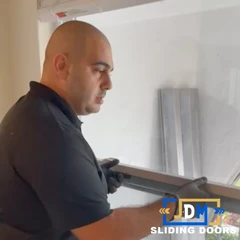
From the field, Yuval, JDM elite technician: “A lot of people think they just need to clean and lubricate the door and it will glide again. Most of the time that is not enough. The rollers, the small wheels the door rides on, wear down, and once they are worn the door drags no matter how clean the track is. Across every sliding door I service, worn rollers are the single most common problem, and they are also one of the fastest things for us to replace.”
Yuval services 20 to 30 sliding doors a week. That is the pattern he sees more than any other, and it is why most of our sliding door repair calls end with a set of rollers rather than a new door. If yours has come off the track altogether, that is a different job.
By the end of this guide you will know: how to tell worn rollers from a dirty track in about two minutes, why the grinding noise is a deadline rather than an annoyance, how long rollers are supposed to last where you live, and what the repair costs.
Why won’t your sliding glass door slide?
Nine times out of ten it is the rollers, the small wheels underneath the panel, not the track. Rollers wear flat, and a flat wheel drags no matter how clean the channel is.
- Lift the door slightly by the handle. If it moves easier, the rollers are worn.
- Grinding or scratching means metal on metal, and that is urgent.
- A clean track is worth doing first, because it is free and rules one thing out.
- A sliding glass door hard to slide in one spot and one that is not sliding well along its whole travel point at different parts, so note where it catches.
- A patio door not sliding smoothly and a sliding glass door that will not move at all are the same fault at two stages, so treat the early one as a warning.
- Rollers are a wear part, like tires, and every sliding door needs a set eventually.
How I know: Yuval, our elite technician, services 20 to 30 sliding doors a week across South Florida, and worn rollers are the most common fault he finds.
Key takeaways
- Cleaning the track fixes a door that is gritty, never one that is dragging on flat wheels.
- The noise is the deadline: worn rollers cut a groove into the track, and that turns a cheap job into a costly one.
- Coastal doors near salt air need rollers every 2 to 5 years; inland doors get 5 to 10.
- Swapping rollers means taking the panel out, which is a two person job on a glass door.
- A door that still slides but complains is the cheapest moment to deal with it.
The two-minute test for a sliding door that is hard to slide
Before cleaning anything, do this.
Lift the door slightly by the handle and slide it. If it suddenly moves more easily when you take some weight off the rollers, the rollers are worn.
Now look at the track. Run a finger along it, carefully. Smooth and even means the track is probably fine. Bumpy, wavy, or with a visible groove worn into it means you have a bigger job than rollers, and the next section explains why.
Listen. Scratching or grinding is not a lubrication problem. It is metal on metal.
The noise is a countdown
This is the part most people miss, and it is what turns a small repair into an expensive one.
From the field, Yuval, JDM elite technician: “When your door starts scratching or making a grinding noise, that is the warning sign. If you keep sliding it on worn rollers, the rollers start chewing into the track underneath. Replace the rollers on time and you usually do not need a new track at all. Let it go too long and now you are paying to fix the track as well. Take care of it as soon as you hear it and you keep the repair small.”
The rollers are a wear part. When they fail, they stop being wheels and start being a chisel. Every slide after that point is cutting a groove into the track the door rides on.
Rollers alone are a straightforward replacement. Rollers plus a ruined track is a different job at a different price, and what decides which one you get is how long you keep using the door after it starts making noise. If your door still slides but has started to complain, our guide to what each sliding door noise means tells you how much time you have.
How long rollers are supposed to last
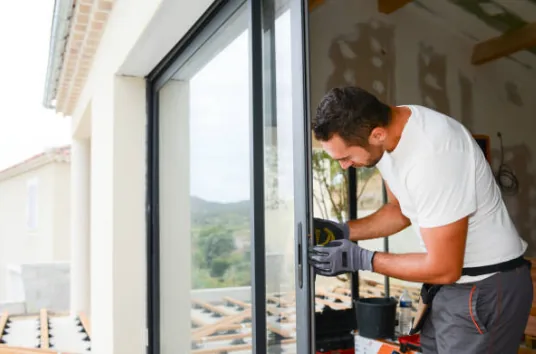
From the field, Yuval, JDM elite technician: “Where you live changes how long rollers last. Near the ocean, salt air is hard on the metal, so coastal doors usually need new rollers every 2 to 5 years. In a clean, inland area a set can last 5 to 10 years. Weight matters too: a heavy glass door and a door you open constantly both wear faster.”
| Situation | Typical roller lifespan |
|---|---|
| Near the ocean, salt air exposure | 2 to 5 years |
| Inland, ordinary conditions | 5 to 10 years |
| Heavy glass panels or constant daily use | Toward the shorter end of either range |
So check your door’s age against that table before you order anything. Rollers are a wear item, like tires, and every sliding door eventually needs a set.
Step 1: Clean the track anyway
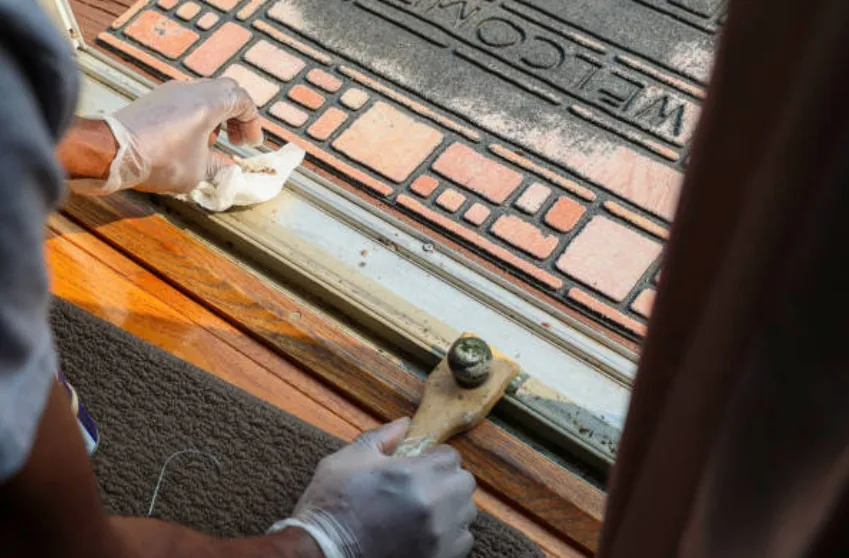
Do it first, because it is free and it rules something out.
- Vacuum the track with a crevice tool to lift loose grit.
- Scrub the channel with a stiff brush and warm soapy water. An old toothbrush reaches the corners.
- Dry it completely.
- Leave the track dry and put the silicone-based lubricant on the rollers instead. This is the one thing most guides get wrong. Andersen’s own care guide says it plainly: “Do not use lubricants on the track itself; this will cause the rollers to slide, not roll.” A wheel that slides instead of rolling develops a flat spot, and a flat-spotted wheel is a replacement rather than a clean. Never oil-based or WD-40 either, which attract dust and make the door worse within weeks.
Slide the door. If it glides properly now, you had a dirt problem and you are done. If it still drags, you have confirmed the rollers.
Step 2: Inspect and adjust the rollers
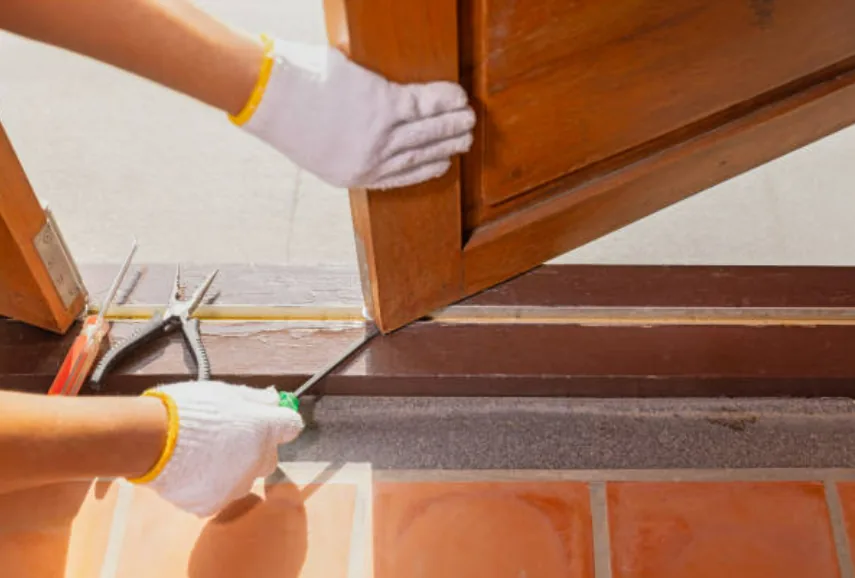
Most sliding doors have adjustment screws at the bottom edge of the panel, usually behind small plastic caps at each end.
To adjust: turn each screw in quarter turns to raise or lower that corner. Raising the door lifts it off a worn spot and can buy time. Test between turns.
To inspect: the honest answer is that seeing the rollers properly means lifting the panel out, which on a heavy glass door is a two-person job with real risk of breaking the glass. If the door is large, impact-rated, or you are working alone, this is the point to stop.
Adjustment is a stopgap. If raising the door helps, that confirms the rollers are worn rather than fixing them.
What replacing the rollers actually involves
People ask whether this is a Saturday job, so here is the real sequence. On a light interior panel it is doable. On a heavy patio slider it is not a solo job, and I say that as somebody who does it for a living.
1. Clear the area and lay something soft down. You are going to put a glass panel on the floor. Move the furniture and the rug first.
2. Vacuum the track before anything else. A clean channel makes the panel go back in far easier, and it lets you see whether the track is already grooved.
3. Drop the panel all the way down. Pop the plastic caps off the bottom corners and turn both adjustment screws counterclockwise as far as they go. That gives you the clearance to lift the panel clear.
4. Take the interior stop strip off. It runs the height of the frame on the inside and is held by screws down its length. Some doors let you tilt the panel out without this; most do not.
5. Lift the panel straight up, then tilt the bottom toward you. One person each side. It clears the track at the top of the lift. Our walkthrough on how to remove a sliding glass door covers the head stop and the anti-lift screws.
6. Photograph the old rollers before you throw them out. Wheel diameter, body width, mounting style. That photo is what gets you the right part rather than a second trip.
7. Fit the new ones the same way round, then reverse the steps. Top of the panel into the upper guide first, then lower the bottom in.
8. Raise the door back up in quarter turns. Both sides, evenly, until the space along the frame edge looks even top to bottom.
Stop at step 3 and call somebody if the panel is impact-rated, taller than you, or if you are on your own. A dropped slider is a far bigger bill than a set of rollers.
Step 3: Check the track for damage
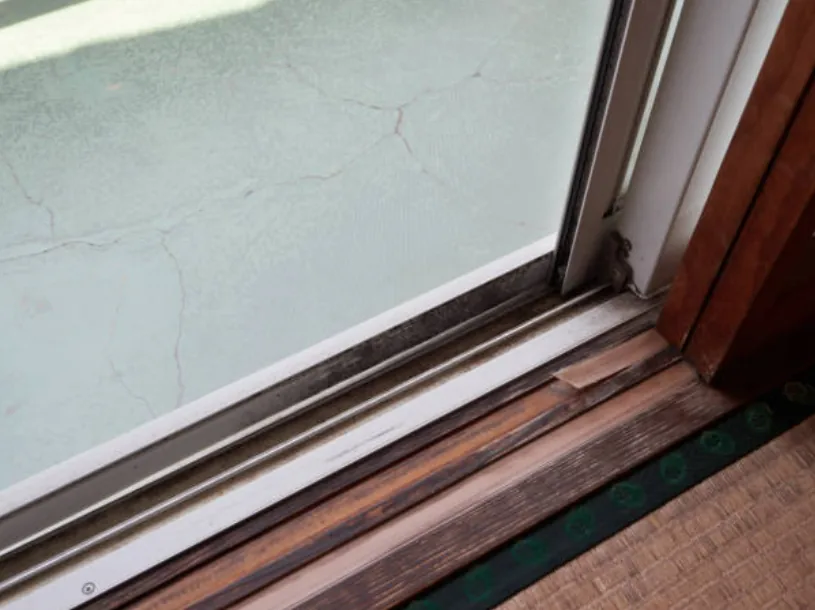
Look down the length of the track at a low angle. You are checking for:
- A groove worn into the running surface.
- Bent or flattened sections, usually where the door sits when closed.
- Waviness rather than a straight line.
Minor burrs can sometimes be filed smooth. A track with a groove cut into it needs a track cap or replacement, because new rollers dropped into a damaged track wear out quickly and you will be doing the job twice.
Step 4: Check alignment
If the door drags only at one end of its travel, or it rubs the frame at the top or bottom, the panel is out of square rather than rolling badly.
Use a level against the door edge, not the frame, since older frames are often out of plumb themselves. Correct with the same roller adjustment screws, one corner at a time.
Weatherstripping
Worn weatherstripping does not usually stop a door sliding, but hardened or displaced stripping can bind against the frame and add drag. If the seal is brittle, cracked, or hanging loose, replacing it is cheap and improves sealing at the same time.
Measure the old roller before buying, because one roller does not fit every door.
What the repair costs
These are national averages from home services cost trackers, not quotes. Your area and door type will move the number.
| Job | Typical professional cost |
|---|---|
| Roller replacement | about $405 |
| Track repair | $75 to $300 |
| Roller replacement plus bent bottom track | about $635 on a large or heavy-panel door |
| Full sliding door repair, all types | $200 to $800 |
Roller and track replacement averages about $405 on a standard door and about $635 on a large or heavy-panel one, while the rollers themselves are only $25 to $40 a pair. The gap is labor: the panel has to come out of the opening and go back in square. Sliding door repair across all job types averages $200 to $800, with most falling between $150 and $600. Heavy or impact-rated doors sit at the top of these ranges because the panels need two technicians to handle safely.
Notice the shape of that table. Rollers on their own are the cheap outcome. Rollers plus track is roughly double. That difference is the cost of ignoring the noise.
When to call a professional
Call if:
- The door is heavy glass or impact-rated and needs lifting out.
- The track already has a groove worn into it.
- Adjustment helped briefly and the dragging came back.
- The door has come off its track, covered in our guide on sliding doors that jump off the track.
- You cannot identify the roller type to order a replacement.
Roller systems vary between manufacturers and model years. Matching the wrong set is the most common reason a DIY replacement fails.
Frequently asked questions
Do I replace both rollers or just the bad one?
Both. They wear at the same rate and they carry the panel together, so a new wheel next to a worn one puts the door out of level and chews the new one early. The part is cheap; the labor is taking the panel out, and you do not want to do that twice.
Will new rollers fix a door if the track already has a groove in it?
Partly. The door will slide better straight away, but new wheels running in a grooved channel wear faster and the door can pull to one side. Where the groove is shallow, a track cover fits over the damage. Where it is deep, the track gets replaced.
My door slides fine but the lock will not catch. Same problem?
Usually a different one. A lock that misses its keeper is an alignment issue, and you fix it by adjusting the roller height or moving the keeper plate. Our guide to a sliding door lock that stopped working covers which one you have.
My door only sticks in one spot. What does that mean?
A repeatable catch at the same point is a defect in the track at that point, not general wear. Something has dented it, or debris has packed into one section. That is good news, because a local problem is a local fix.
Should I just replace the whole door instead?
Rarely worth it for a sliding problem. A set of rollers is a fraction of a new door, and the panel and glass are usually fine. Replacement makes sense when the frame is corroded, the glass seal has failed, or you want an impact rating you do not currently have.
Get it looked at before it eats the track
If your sliding door is dragging, and especially if it has started to scratch or grind, the rollers are the likely cause and the track is on a clock.
Replace the rollers in time and the track usually survives untouched. That is the difference between a small repair and a large one, and it is decided by how quickly you act after the noise starts.
Book a sliding door repair and we will check the rollers and the track together, so you know whether you caught it early enough. We also handle pocket door repair, commercial door services, and sliding door replacement.