A patio door part has to match the door it goes on. So when a roller gives out or a screen tears, the parts store or the repair company asks for a measurement before it will quote the job or order the part. That is why you want to know what the standard sliding glass door size is, whether yours is one of them, and which measurement to read out.
Yours is almost certainly standard. Patio doors are sold as 5, 6 or 8 feet wide and stand 6 feet 8 inches tall, and that list has barely moved in fifty years.
What happens if you give the wrong measurement is that it costs you twice. The part that arrives does not fit, so the door stays broken another week. And a door that reads as an odd size gets quoted as a custom replacement, which runs to thousands when a repair would have fixed it.
By the end you will know the standard sizes by panel count, why a 6-foot door does not measure 72 inches, how to measure yours in three numbers, which of those numbers your parts get ordered from, and when an odd measurement means a custom door.
I am Gal Cohen, field area manager at JDM Sliding Doors, which is a sliding door repair company working in six states. The number people read out to me on the phone is usually the wrong one of three.
Key takeaways
- The piece of a sliding glass door that slides is called the panel, and it comes out a little under half the width of the whole door.
- Measure the panel when you are buying rollers, a handle, a lock or a screen, because those parts are made to fit the panel and not the whole door.
- Measure the whole door in three places and write down the smallest of the three, because old aluminum frames sag and the three readings will not match.
- A sliding glass door that is more than an inch off every size on the list is usually an older standard size rather than a custom door.
The standard sliding glass door size list
Short answer: a standard sliding glass door is 5, 6 or 8 feet wide and 6 feet 8 inches tall. Doors with three or four panels run roughly 10, 12 or 16 feet wide, and the taller ones come in 6 feet 11 inches or 8 feet.
Where that comes from: Andersen publishes the sizes of all six of its gliding patio door lines, and every one is built on those same three heights.
A sliding door is made of big pieces of glass in frames, set side by side. One piece slides and the other stays still, and each piece is called a panel. The more panels a door has, the wider it is, which is most of what separates the sliding door types you see in houses.
Here is the one thing to expect before you pick up a tape. The size a door is sold under is rounded off, so your own measurement will not match it exactly. A door sold as a 6 foot does not measure 72 inches. It measures 5 feet 11 1/4 inches or 6 feet 3/4 inch depending on who made it, the same way a 2x4 board is not two inches by four. Andersen prints the real fractions line by line, and this table puts the rounded name next to them.
| How it is sold | Panels | What it actually measures |
|---|---|---|
| 5 foot | Two | 5 ft 0 in |
| 6 foot | Two | 5 ft 11 1/4 in to 6 ft 0 3/4 in |
| 8 foot | Two | 8 ft 0 in to 8 ft 0 3/4 in |
| 10 foot | Three or four | 9 ft 9 3/4 in to 9 ft 10 in |
| 12 foot | Three or four | 11 ft 9 3/4 in to 11 ft 10 in |
| 16 foot | Four | 15 ft 9 3/4 in to 15 ft 10 in |
If your reading sits within an inch of a row, that is your row. Now you know which name your door was sold under.
The three measurements on your door

Stand outside the door and you can see all three sliding glass door dimensions at once. The biggest is the whole door, measured across the outside of the frame, and that is the number a brand new door gets priced from. Next is the sliding panel, meaning just the piece that moves; it comes out a little under half the width of the whole door, because the two panels overlap in the middle where the lock sits. The smallest is the opening you actually walk through, because the frame and the panel that stays still both take up room.
Somebody asking you for a measurement usually wants the middle one and gets handed the biggest. So here is how the rest of this goes: measure, match, then decide. If you skip the panel, you are back here the next time the door needs a part.
Step 1: Take all three measurements
This is the part you do with a tape in your hand. You need a steel tape and five minutes, and it is easier from outside, because the outside of the frame is the edge everything else is measured from. Here is the order a technician takes them.
- The whole door. Measure across the outside of the frame at the top, the middle and the bottom, and write down the smallest of the three. Old aluminum frames sag a little over the years, so the three readings will not match, and the smallest one is what a new door has to fit through.
- The height. Measure from the sill, which is the metal track the door sits in down at floor level, up to the top of the frame. Take it on the left, in the middle and on the right, and again keep the smallest.
- The sliding panel. Push the panel that moves to the middle of the opening, then measure that piece on its own, side to side and top to bottom.
Measuring for a screen is its own job, with its own steps.
Step 2: Work out which number your part comes from
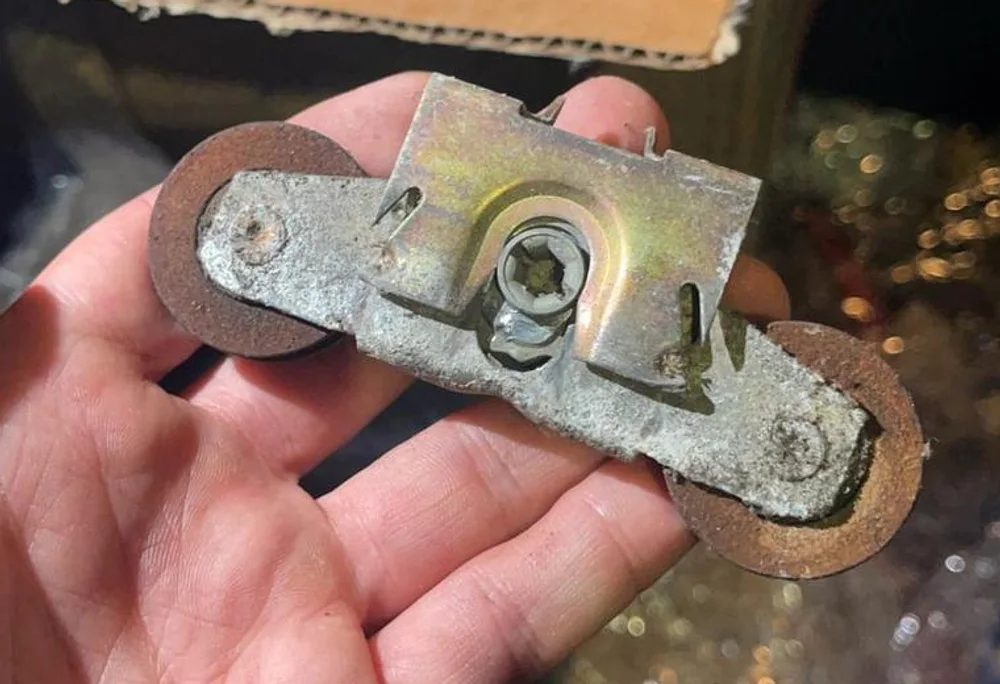
Photo: JDM Sliding Doors, from our own repair calls.
You have three numbers written down now, and only one of them is the one to read out. Nothing you buy for a sliding door is sized off the whole unit, so here is which measurement each part is actually ordered from.
| What to measure | What it is for | Where the tape goes |
|---|---|---|
| The sliding panel, width and height | A replacement panel, and the size a new screen is built to | Across the frame of the piece that moves, outside edge to outside edge |
| The bottom edge of that panel | Rollers | The bottom of the moving panel, including the slot the roller drops into |
| The track, across the top | The shape of the roller wheel, and a track cover | The raised metal rail the panel rides on |
| The upright edge of the panel | A handle or a lock | Middle of one handle screw hole to the middle of the other |
| The whole frame, outside to outside | A whole new door, and nothing else | Top, middle and bottom of the outside of the frame |
Rollers are the row that catches people out. These are the small wheels the door rides on, two sets of them, hidden inside the bottom edge of the sliding panel, and a pair of wheels on one metal bracket is called a tandem roller. The wheel has to match the shape of the track as well as the slot it drops into, which is why the track gets a row of its own.
What happens if you read out the whole-door number instead is a part that does not fit and a second trip to the store. If your door drags as it slides, the signs that rollers are worn come first.
Step 3: Check your reading against the list
Take the whole-door number from step 1 and look for it in the table above. If it is within an inch of a row, your door is a stock size and you are done.
If it is further off than that, there are two ordinary explanations to rule out before anybody says the word custom. The first is that your door is an older standard size. Aluminum sliding doors built from the 1960s through the 1990s were made to size lists that have changed since, so a door that looks odd against today’s catalog may have been perfectly ordinary when your house went up. The second is that you measured the hole in the wall rather than the door itself. That hole is called the rough opening, and builders cut it a little bigger than the door on purpose, so there is room to straighten the door as it goes in. Measure that and no stock size will ever match.
If neither explains it, your door may really be custom, and that is not a dead end. Andersen builds custom sizes in 1/8 inch steps. The catch is the bill: a stock door is already built and sitting in a warehouse, while a custom one has to be made for you, and it brings the framing, the finish work and the permit along with it. So price a repair first. What a replacement costs is worth reading before a tape measure sends you there.
What you get if you hand the measuring to us
A measurement over the phone is a guess until somebody has the panel in front of them. When we come out we measure your panel and your old roller on site, so the part that turns up is the part that fits, rather than the nearest thing in a catalog.
While the panel is off we also find out why it broke, which matters more than it sounds. A panel that has sagged measures short at one end, and it will chew through new rollers until somebody straightens it. We check the track for the same reason before the new roller goes in, because a worn track wears a new roller out just as fast as it wore the last one.
Our work carries 6 months on the parts we supply and 1 year on our own installation, across sliding, pocket, barn and screen doors.
Frequently asked questions
Do I have to take the door out to measure the panel?
No. Slide the moving panel to the middle of the opening, where you can reach both of its upright edges, and measure the panel frame itself rather than the glass. Taking a panel out is a two-person job and you do not need to do it just to get a number.
What if my two panels are not the same width?
Some doors are built that way, usually with a wider fixed panel and a narrower one that slides. Measure the one that moves. That is the panel your rollers, handle and lock have to fit, whatever the other one does.
Can I put a wider sliding door in the same opening?
Only by rebuilding the opening. The header, which is the beam across the top of the opening, carries the roof load, so a wider door needs a new one sized by somebody qualified.
Is there a code that sets a minimum size for a sliding glass door?
No. The International Residential Code requires one exit door per home at 32 inches clear and 78 inches high, and it has to be side hinged, so a patio slider never counts as that door. Slider sizes are a market habit, not a rule.
Get your sliding door measured properly
If a hardware store has already sent you the wrong roller, or the door drags badly enough that you have started pricing a new one, the measurement is where to restart.
JDM Sliding Doors handles sliding door repair, rollers, tracks, locks and handles across South Florida and our other markets. Send a photo of the panel edge and the bottom track and we will tell you what fits. Schedule a free repair estimate.