
Short answer: Yes. A pocket door is a good choice in humid South Florida, but only when four things fit the climate: a dimensionally stable or fully sealed door panel, corrosion-resistant aluminum or stainless track and rollers, smart placement away from unventilated wet rooms, and a simple maintenance routine. Get those right and the door slides smoothly for years; cut corners on the panel or the in-wall hardware and you’re looking at service calls, or even drywall repair. Because the working parts hide inside the wall, the decisions you make before installation matter far more here than in a dry inland climate.
Pocket doors are one of the most popular space-saving choices in 2026 home remodels across Miami-Dade, Broward, and Palm Beach. They disappear into the wall, free up swing space, and give a room a cleaner, more modern feel than a traditional hinged door. But installing a pocket door in Florida is not the same project it is up north. Peak summer humidity, the long rainy season, and salt air all push harder on the door panel, the in-wall track, and the rollers hidden inside the wall, so the choices you make before the door goes in largely determine whether it still slides smoothly five years later.
We’re JDM Sliding Doors, based in Fort Lauderdale, and we install and service pocket doors across South Florida every day, so this guide reflects what actually holds up in this climate, not generic advice. It walks through what South Florida homeowners should think through before the wall is opened up: how a pocket door actually works, whether it’s a good fit for a humid climate, the materials and hardware worth paying for, where to place it, and the maintenance routine that keeps it sliding. If you want a head-to-head comparison with standard sliders, our Sliding Doors vs Pocket Doors: Pros, Cons, and How to Choose post covers that separately. If you want to see panel styles before deciding, our 10 Types of Pocket Doors for Your Home guide is the right starting point.
Key Takeaways
- A pocket door works well in humid South Florida when the panel, hardware, placement, and upkeep all suit the climate; almost every long-term complaint traces back to one of those four being wrong, not the design itself.
- Panel matters most: choose engineered/laminated wood, a solid-core door sealed on all six faces, or a glass panel in an aluminum frame; raw or partly sealed solid wood swells and binds in the humidity.
- Hardware lives inside the wall, so spend on heavy-gauge aluminum or stainless track, sealed-bearing rollers, and stainless or coated pulls and latches; they resist the salt air and are hard to reach later.
- Avoid unventilated wet rooms; a pocket door can serve a bathroom only if the exhaust fan is properly sized and ducted outside.
- Light maintenance keeps it sliding: clean the track, use dry silicone (never oil or graphite), keep indoor humidity around 40% to 55%, and act on early drag before it becomes a wall repair.
- Installation is professional work: anchoring an in-wall frame and matching it to the rough opening is best scoped by an installer who works in South Florida homes.
How a Pocket Door Works, and Why the In-Wall Design Matters in a Humid Climate
A pocket door panel hangs from rollers that ride along a horizontal track at the top of the rough opening. When you slide the door open, the panel disappears into a hollow “pocket” framed inside the wall cavity. That pocket is bordered by split studs on each side and is usually built from a pre-engineered frame kit installed before drywall.
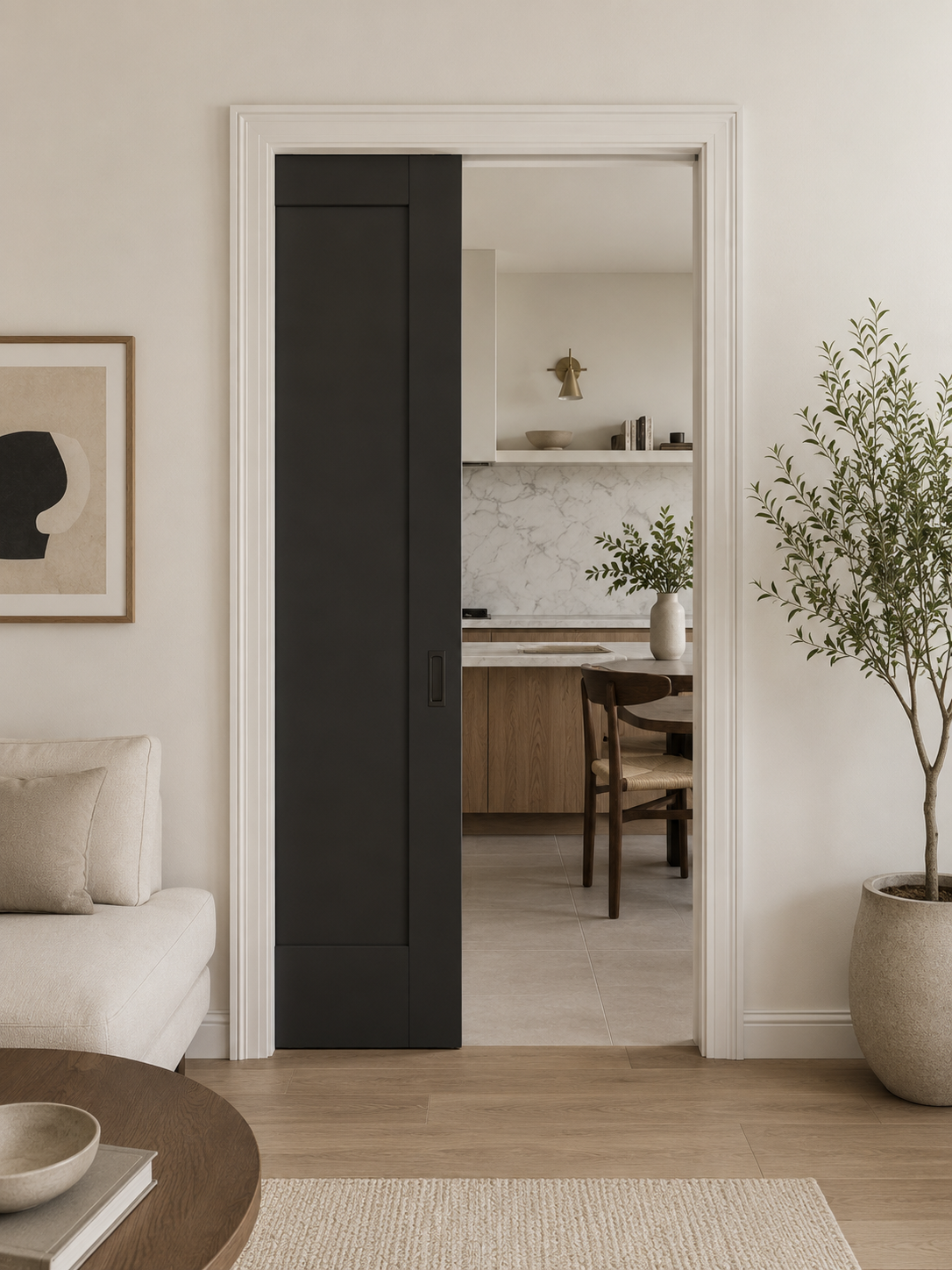
The reason this matters in South Florida is straightforward: most of the working parts (track, rollers, hangers, sometimes a soft-close mechanism) sit inside a wall cavity you cannot easily open. In a dry climate that’s not a big deal. In a coastal subtropical climate where indoor relative humidity often sits well above 50% for much of the year, the wall cavity stays humid too. Plain steel hardware can begin to surface-rust. A wood door panel can absorb moisture, swell across its width, and start to bind in the pocket. And once the door is rubbing or jumping the track, getting to the hardware means cutting open drywall.
None of that disqualifies pocket doors here. It just means the design decisions made before installation carry more weight than they do up north.
Are Pocket Doors a Good Idea in a Humid Climate Like South Florida?
Short answer: yes, with the right material, hardware, and placement choices. Pocket doors install successfully in homes and condos across Fort Lauderdale, Miami, Boca Raton, and the Palm Beaches every year. The honest, balanced take looks like this.
Where pocket doors work well here
- Conditioned interior walls between living spaces, bedrooms, home offices, and closets, where the HVAC is keeping humidity in a reasonable range.
- Small rooms and tight floor plans where a swinging door would eat usable square footage. South Florida condos and remodeled mid-century homes are full of these spots.
- Openings where you want a clean architectural line and don’t want a door visible when it’s open.
Where they need more care or aren’t the right call
- Walls that share a face with an unconditioned space, an attic, or the building exterior in older construction, where temperature and humidity swings are larger.
- Doorways into rooms with heavy moisture loads and poor ventilation. A pocket door can serve a bathroom, but only if the exhaust fan actually moves the air it needs to.
- Load-bearing walls or walls packed with plumbing and electrical, where carving out a pocket isn’t practical or affordable.
The realistic trade-off is this: a pocket door uses parts that are harder to reach once the wall closes up. In a humid climate, “harder to reach” raises the cost of using cheap hardware or the wrong door panel. Spend the money once on materials built for this environment, and a pocket door is a perfectly sensible choice in South Florida. Cut corners on the panel or the rollers, and you’ll be paying for service calls (or worse, drywall repair) within a few seasons.
Choosing Materials and Hardware That Survive Humidity and Salt Air
The materials that survive a humid, salty South Florida climate are a dimensionally stable or fully sealed door panel, heavy-gauge aluminum or stainless track, sealed-bearing rollers, and stainless or coated hardware. This is where most of the long-term outcome is decided, across three categories: the door panel itself, the track and roller system, and the smaller hardware (pulls, latches, edge guides).
Door panel. Solid wood is the look most homeowners want, but raw or poorly sealed wood is the single biggest source of pocket-door problems in Florida. Wood is hygroscopic; it absorbs and releases moisture as humidity changes, and it moves dimensionally as it does. In a humid season the panel can swell enough to rub the inside of the pocket or drag on the floor. Practical options:
- Engineered or laminated wood panels designed for dimensional stability, which move far less with humidity than solid wood.
- Solid-core wood doors that are fully sealed on all six faces, including the top, bottom, and inside the pocket-side edges. Many factory finishes only coat the visible faces, which leaves the back, top, and bottom exposed to soak up moisture.
- Glass panels in an aluminum or stainless frame, which sidestep wood movement entirely.
- MDF only if it is rated for high-humidity environments and edge-sealed; standard MDF is not a good fit near a coastal climate.
Track and rollers. The track and roller assembly is the part you most want to get right because it lives inside the wall. Look for:
- Heavy-gauge aluminum or stainless track rather than thin plain steel.
- Sealed-bearing nylon or ball-bearing rollers rated for the door weight, not the bargain rollers bundled with low-end frame kits.
- A pre-engineered pocket door frame from a reputable manufacturer rather than a job-site-built pocket, so studs stay straight and the track stays level.
Smaller hardware. Pulls, edge pulls, privacy latches, and floor guides are exposed to indoor air all day. In coastal homes within a few miles of the ocean, salt drift makes its way inside, and chrome plating or cheap zinc alloys can pit and dull faster than they would inland. Stainless steel (300-series), solid brass with a quality clear coat, or quality powder-coated finishes hold up best. It’s a small line item that pays back in appearance over years.
If a contractor is quoting “standard hardware” without specifying which track, which roller, and what the door is sealed with, that’s the moment to ask for the specifics in writing.
Installation and Placement Decisions
Where the door goes matters almost as much as what it’s made of. A few rules of thumb for South Florida installations:
Avoid unventilated wet rooms. Pocket doors can work for a bathroom, but only if ventilation is doing its job. The exhaust fan should be properly sized for the room and ducted outside, not into the attic. If the room fogs up the mirror after a shower and stays that way for an hour, that same moisture is loading the wood panel and the pocket cavity. A swinging door is sometimes the better call for a heavy-use shower bathroom.
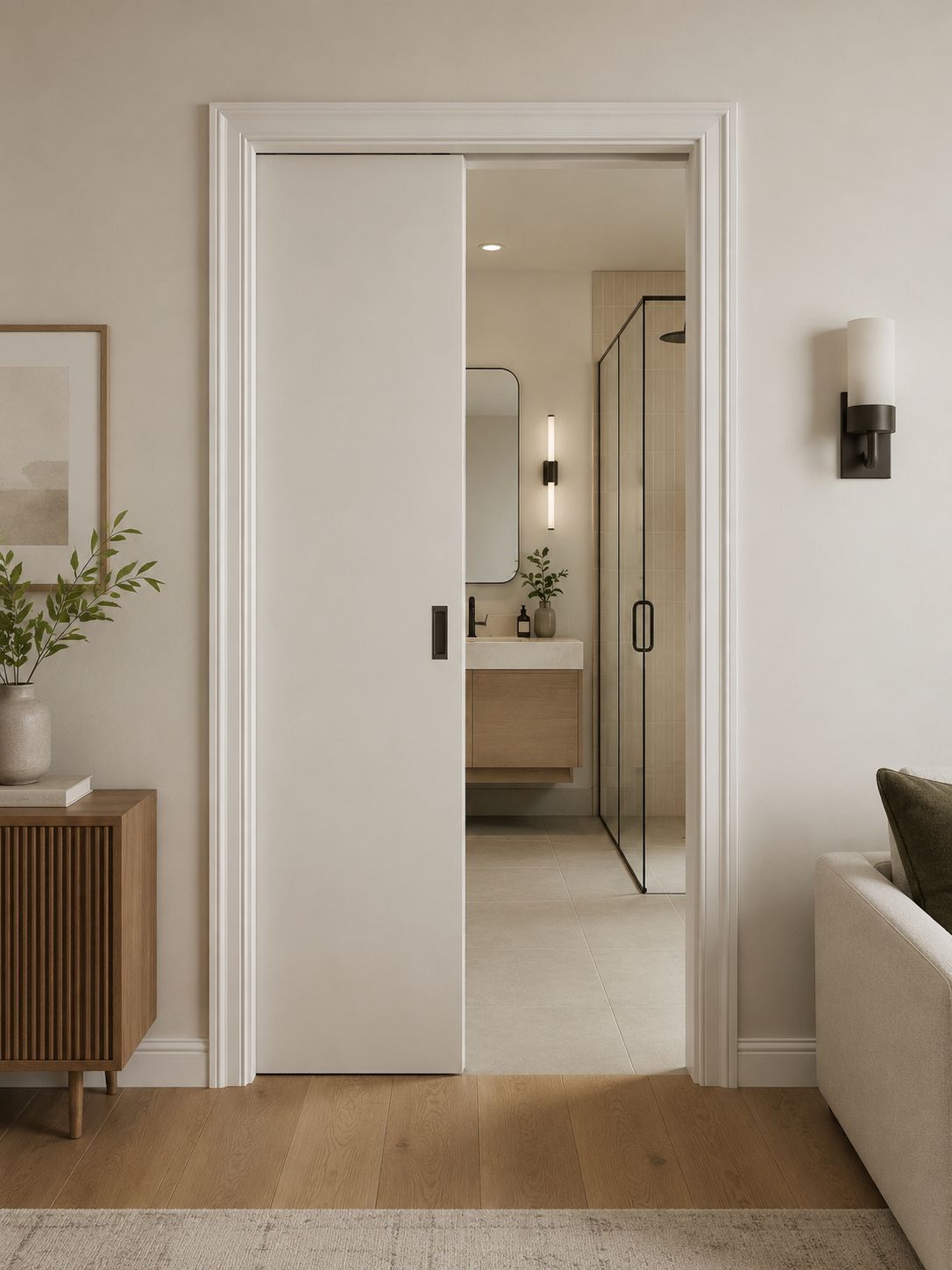
Leave clearance. Plan for a small gap between the door bottom and the finished floor, typically about a half inch. Floors that get mopped, tile that’s slightly out of level, and seasonal panel expansion all eat into a too-tight gap and create drag.
Plan for future access. Several details make life dramatically easier when the door eventually needs service:
- Use a frame kit that lets you lift the door off the track from the strike side without demolishing drywall.
- Avoid running plumbing supply or drain lines through the pocket cavity. A small leak inside a pocket is a much bigger repair than a leak inside an open wall.
- Keep low-voltage runs (data, security) out of the pocket where reasonable.
Mind exterior and party walls. Older Florida construction often has masonry exterior walls and interior partitions that are not built for being hollowed out. A pre-install assessment by an installer who works in homes like yours is worth more than a generic spec sheet.
Match the panel to the opening. A common mistake is ordering an off-the-shelf door without checking that the pocket frame and rough opening match. South Florida homes built across very different decades vary a lot in wall thickness and stud spacing; this is something to confirm before, not after, the wall is open.
If you’d rather have someone scope this in person before ordering anything, our pocket door installation page is the right starting point.
Maintenance to Keep It Sliding for Years
Pocket doors are not high-maintenance, but a small routine extends their life noticeably in a humid climate.
- Track cleaning every few months. Dust and lint collect in the top track and gradually load the rollers. A vacuum brush attachment and a damp cloth on the visible portion of the track is enough for a routine pass. Heavier cleaning is best done when you have the door panel down.
- Lubrication, but the right kind. Use a dry silicone spray on the track and roller wheels. Avoid oil-based or graphite lubricants; they attract dust, then turn into a sticky paste that wears rollers faster.
- Humidity control indoors. Keeping indoor relative humidity in the 40% to 55% range during the summer is good for the door, the rest of the woodwork in the house, and your A/C bill. A properly sized HVAC system and, if needed, a whole-home dehumidifier do more for pocket door longevity than any single piece of hardware.
- Watch for early warning signs. A door that suddenly drags, a roller that ticks audibly, or a panel that no longer sits flush in the closed position is the door telling you something has shifted. Catching it early usually means a small adjustment instead of a wall repair. Our pocket door repair service page covers what those service calls typically involve.
- Clean salt residue near the coast. Homes within a mile or two of the ocean get measurable salt deposition indoors during windy weeks. A periodic wipe-down of exposed hardware with a damp microfiber cloth, followed by drying, keeps finishes looking right.
A pocket door in a South Florida home is a perfectly reasonable choice when the materials, hardware, placement, and maintenance routine all fit the climate. Almost every long-term complaint about pocket doors here traces back to one of those four being wrong, not to the design itself.
Frequently Asked Questions
Are pocket doors a good idea in humid South Florida?
Yes, and we install them successfully in homes and condos across Fort Lauderdale, Miami, Boca Raton, and the Palm Beaches every year. In my experience the key is matching the panel, hardware, placement, and maintenance to the climate: the humidity only becomes a problem when corners get cut on the door panel or the in-wall hardware, which is exactly where we see the failures down the road.
What pocket door material holds up best in a humid, salty climate?
The materials we trust here are engineered or laminated wood, a solid-core door sealed on all six faces (including the top, bottom, and pocket-side edges), or a glass panel in an aluminum frame, since all of them resist humidity well. Raw or partly sealed solid wood is the single biggest source of pocket-door problems we get called out for in Florida, because it absorbs moisture, swells, and binds inside the pocket.
Can I put a pocket door in a bathroom?
You can, but in my experience it only works if the exhaust fan is properly sized and ducted outside, not into the attic. When we see a room that stays foggy long after a shower, that same moisture is loading the door panel and the pocket cavity, so for a heavy-use shower bathroom we’ll often tell a homeowner a swinging door is the smarter call.
How do I maintain a pocket door so it keeps sliding?
The routine we give every customer is simple: clean the top track every few months, lubricate the track and rollers with a dry silicone spray (never oil-based or graphite products, which attract dust and gum up the rollers we end up replacing), and keep indoor humidity around 40% to 55%. Watch for early warning signs like sudden drag or a ticking roller, because in our experience catching them early usually means a quick adjustment instead of opening up the wall.
Should I install a pocket door myself?
I’d steer most homeowners away from it: installing a pocket door means opening the wall, setting an in-wall frame perfectly plumb and level, and matching it to the rough opening, and we find older Florida construction varies a lot in wall thickness and stud spacing. The reason we recommend a pro who installs in South Florida homes is simple: a mistake hides inside a finished wall, so fixing it later means cutting open drywall.
If you’re weighing a pocket door for an upcoming renovation in Miami-Dade, Broward, or Palm Beach and want a professional look at the opening before you commit, contact us today for a free consultation, or book an appointment for an in-home assessment.